
The Art of the Rolled Hem: Understanding a True Sign of Quality
Why the smallest detail in a silk scarf often tells the biggest story
There are moments in luxury where scale becomes irrelevant. Where the value of an object is not announced by size, spectacle or branding, but by a detail so quiet it almost escapes notice. In silk scarves, that detail is the rolled hem. A slim, curved edge no wider than a matchstick. A finish many people admire without fully understanding. And yet, for those who know, the rolled hem is one of the clearest indicators of quality, craft and intent.
This article explores why. Not as a technical manual, but as a cultural and commercial story. Because the rolled hem is not simply a method of finishing fabric. It is a signal. One that speaks to heritage, patience, labour, and the philosophy of making things well. In a market crowded with claims of luxury, the rolled hem remains one of the few details that rarely lies.
Silk scarves occupy a unique position in fashion. They sit at the intersection of art, utility and personal expression. Unlike garments, they are not shaped by the body. Unlike jewellery, they rely on softness rather than permanence. Their value is therefore carried by material, design and finish. Remove any one of these, and the illusion collapses. The rolled hem is the final act that binds these elements together.
To understand its importance, we need to slow down. To look closely. And to appreciate why this particular edge has become shorthand for excellence.
The rolled hem has its origins in European silk traditions, particularly in France and Italy, where silk accessories were refined alongside couture rather than mass fashion. Historically, scarves were finished by hand not out of romance, but necessity. Early looms produced cloth that required careful edge treatment to prevent fraying. Rolling and stitching the hem inward protected the silk while preserving its drape.
Over time, this necessity became an aesthetic choice. The rolled hem evolved into a visible mark of refinement. A way to finish a scarf without breaking the visual rhythm of the design. Unlike a flat, machine stitched hem, which creates a hard line and slightly stiffens the fabric, a hand rolled hem disappears into the silk. It allows the design to flow uninterrupted to the very edge.
This mattered. Scarves were often designed as complete compositions. Borders, motifs and colour fields were intended to breathe right up to the perimeter. A bulky or uneven finish would disrupt this balance. The rolled hem solved the problem elegantly.
What began as practical craftsmanship became a language. A way for makers to quietly say, this was done properly.
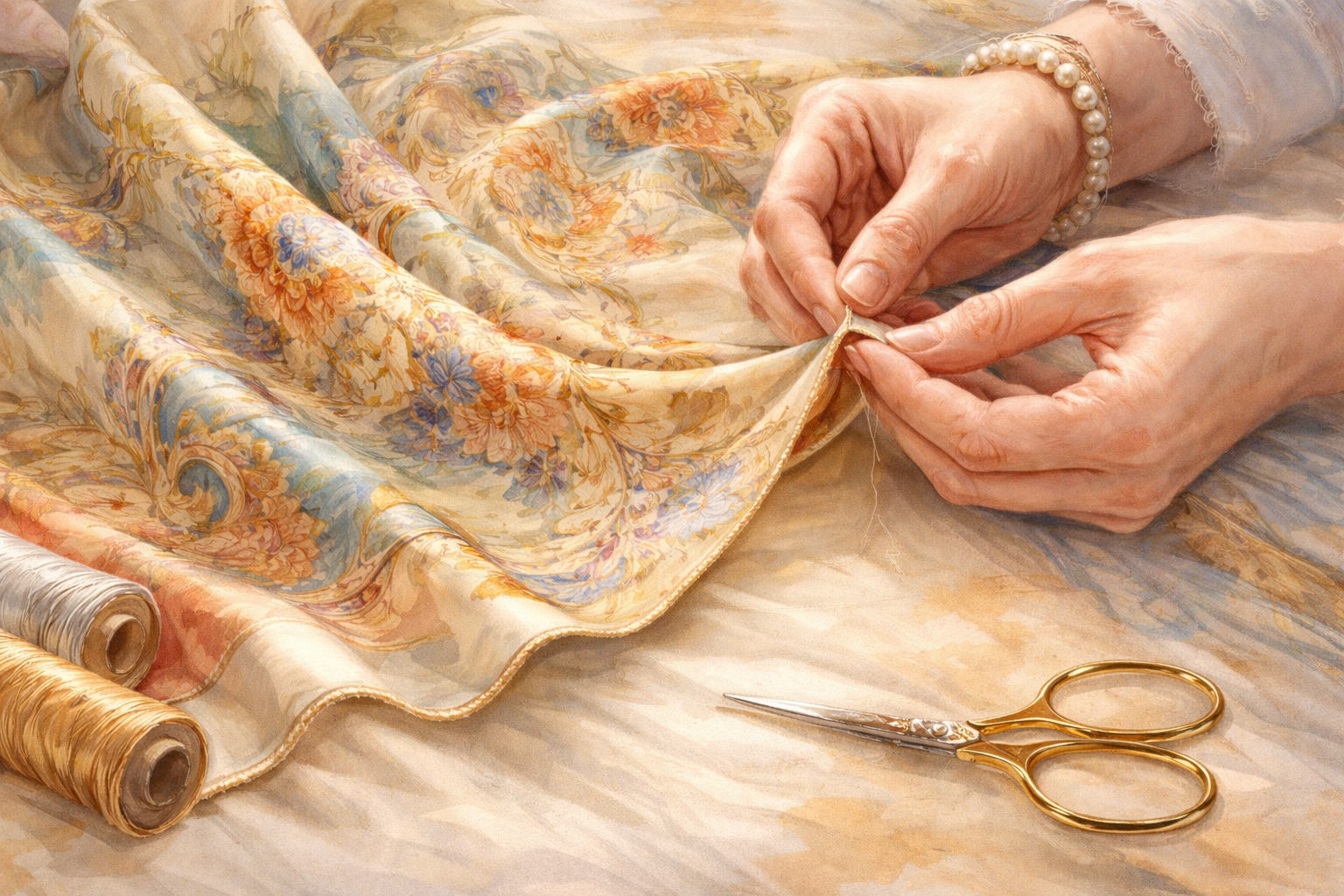
A true hand rolled hem is created by folding the very edge of the silk inward, rolling it between the fingers, and stitching it down with tiny, almost invisible stitches. The process is slow and requires skill that can only be developed through repetition. Even experienced artisans work methodically, centimetre by centimetre, maintaining consistent tension and width throughout.
The result is not uniform in a mechanical sense. And that is precisely the point. If you examine a hand rolled hem closely, you may notice minute variations. Slight changes in stitch spacing. A gentle irregularity in the roll. These are not flaws. They are evidence of human touch.
Machine rolled hems, by contrast, prioritise speed and consistency. They use overlocking or narrow hemming machines that compress the silk and lock the edge with thread. While neat, they tend to flatten the fabric and introduce a subtle stiffness. The edge becomes a boundary rather than a continuation.
From a branding perspective, this distinction matters enormously. Luxury consumers are increasingly fluent. They look for proof, not promises. The rolled hem offers that proof in a way that is both tangible and emotionally resonant.
There is also a material conversation happening at the hem. Silk, particularly high quality mulberry silk, is a living material in the sense that it responds to handling. Its fibres are long, smooth and lustrous, but also delicate. A poor finish can cause snagging, distortion or premature wear.
Hand rolling respects the nature of silk. By gently turning the edge inward, the raw fibres are protected without compression. The scarf retains its fluidity. It moves as silk should move. Light catches the edge softly rather than abruptly.
This is why rolled hems are most often found on scarves made from heavier silk weights. An 18 momme silk, for example, has enough substance to hold a roll beautifully. Lighter silks can be rolled, but the skill required increases significantly. The hem must be secure without becoming bulky. Achieving that balance is a mark of exceptional craftsmanship.
From the wearer’s perspective, these decisions translate into experience. A scarf with a hand rolled hem feels different in the hand. It ties more gracefully. It holds a knot without fighting back. Over time, it develops character rather than fatigue.
The marketing language around luxury often leans heavily on emotion, but the rolled hem is one of those rare details where emotion is supported by fact. It takes longer to make. It requires trained artisans. It cannot be rushed without consequence.
This has implications for scale. Brands that commit to hand rolled hems implicitly accept limitations on volume. Each scarf represents hours of human labour. This is not easily outsourced or automated without losing the very quality being sold.
In an age of acceleration, this slowness becomes part of the story. It aligns with broader cultural movements towards mindful consumption and appreciation of craft. Consumers are no longer impressed by endless choice. They are drawn to objects that feel considered.
The rolled hem communicates consideration without explanation. It does not need a hang tag or a manifesto. Those who recognise it understand immediately. Those who do not may still feel its effects subconsciously. The scarf simply behaves better. It lasts longer. It feels right.
There is also an honesty to the rolled hem that appeals to modern luxury buyers. It is difficult to fake convincingly. A poorly executed roll is obvious to the trained eye. Brands that attempt to simulate the look without investing in the process are quickly exposed.
This creates trust. When a brand consistently delivers hand rolled hems, it signals integrity. It suggests that the same care has been applied elsewhere, in design development, material sourcing, and production ethics.
From a content perspective, the rolled hem offers rich narrative potential. It allows brands to talk about people rather than processes. About skills passed down, hands at work, and time taken. These stories resonate because they rehumanise luxury.
Photographically, the rolled hem is a gift. Close up shots reveal texture and subtle shadow. They invite the viewer to linger. In a digital landscape dominated by speed, these moments of stillness stand out.
There is a temptation in fashion writing to romanticise craft without acknowledging its realities. Hand rolling hems is demanding work. It requires concentration and can be physically taxing. Respecting this labour means valuing it properly.
This is where pricing becomes part of the ethical conversation. A genuinely hand finished scarf cannot be priced as a commodity. When consumers understand what goes into that edge, they are more willing to invest. Not because they are paying for a name, but because they are supporting a standard.
The rolled hem also plays a role in longevity, which is increasingly central to sustainable luxury. A well finished edge reduces fraying and extends the life of the scarf. It encourages repair rather than replacement. Over decades, this matters.
Heirloom pieces often reveal their quality at the edges first. A scarf that has been worn, loved and passed on will show softness rather than degradation if finished well. The hem becomes a witness to time.
In branding terms, this longevity feeds into narrative continuity. A scarf that ages gracefully reinforces the promise made at purchase. It becomes part of personal history. That is powerful.
It is worth noting that not every silk scarf needs a hand rolled hem. Context matters. Contemporary designs, experimental textiles or deliberately graphic aesthetics may call for alternative finishes. The point is not dogma, but alignment.
When a brand positions itself around heritage, artistry and enduring quality, the rolled hem is not optional. It is integral. To omit it would be a contradiction.
Ultimately, the rolled hem is a quiet discipline. It asks makers to slow down and consumers to look closer. It rewards patience on both sides. In a world increasingly shaped by immediacy, this feels almost radical.
The next time you handle a silk scarf, take a moment at the edge. Run your fingers along the roll. Feel the continuity. Consider the time it took. In that small curve of silk, you will find a philosophy of making that still matters.
True quality often lives where few people think to look. The art of the rolled hem reminds us that luxury, at its best, is not about excess. It is about care.