
Silk, Secrecy and the Making of Macclesfield
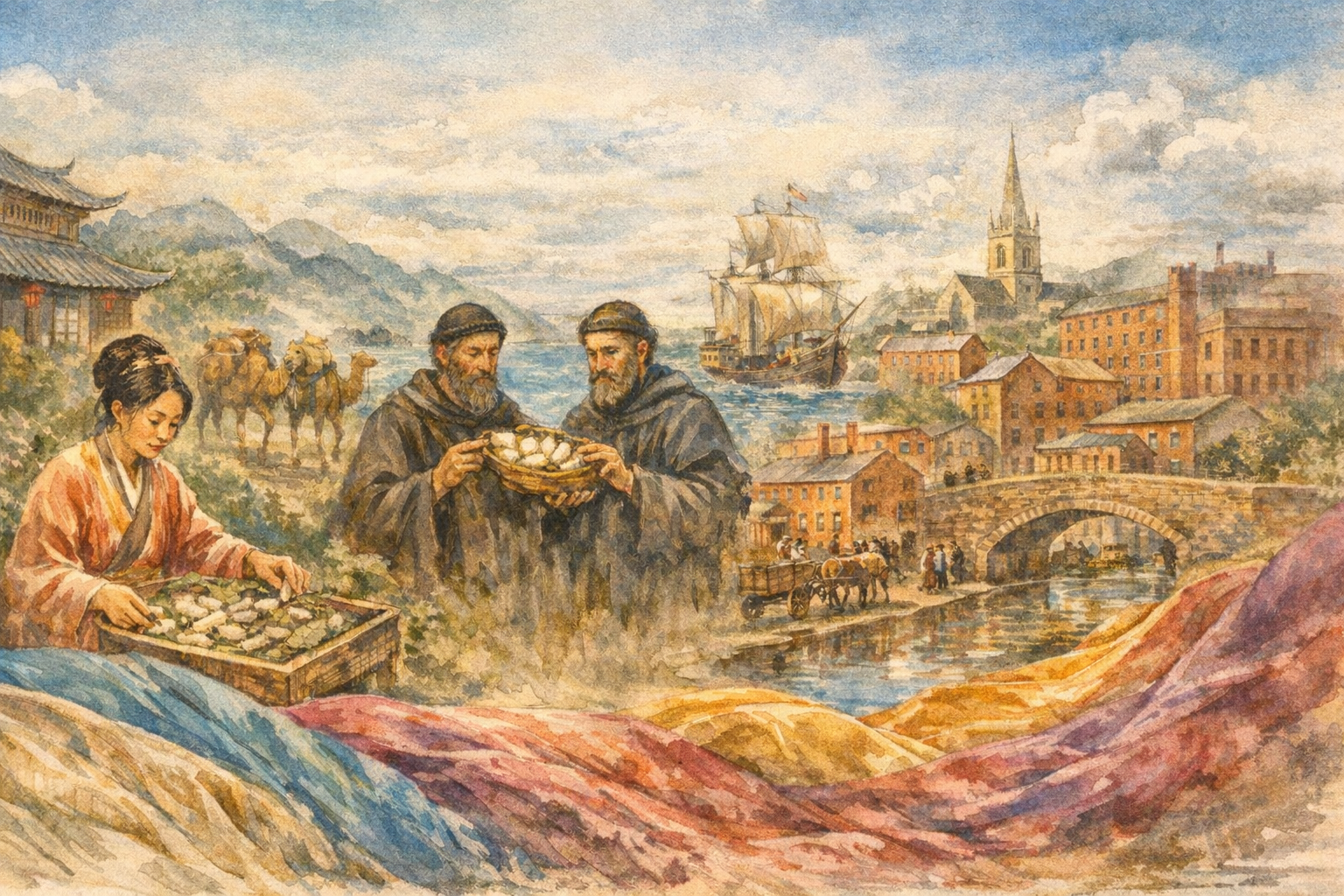
How an ancient guarded fibre travelled across continents to shape Britain’s most refined textile town
Silk has always carried an air of intrigue. It whispers of emperors and caravans, of guarded knowledge and patient hands, of fabric so prized that entire economies bent around its production. Long before it ever reached British shores, silk was already a political object, a diplomatic tool and a symbol of cultural authority. That it would one day underpin the rise of a modest market town in Cheshire seems, at first glance, improbable. Yet the story of silk’s journey to Britain, and the transformation of Macclesfield into the country’s silk capital, is not accidental. It is a tale of secrecy breached, skills transplanted, ambition sharpened by industry and a nation learning how to turn cultural fascination into commercial mastery.
Silk’s origins lie deep in ancient China, where legend and archaeology converge. For centuries, the Chinese state treated sericulture, the cultivation of silkworms and the reeling of their filament, as a strategic secret. The value of silk was not merely aesthetic. It functioned as currency, tribute and diplomatic gift. Silk garments conveyed rank and authority. Silk bolts travelled westward along trade routes that would later be called the Silk Road, yet the knowledge of how silk was made remained tightly controlled. Exporting silkworms or their eggs was forbidden. Penalties were severe. This deliberate opacity ensured that China retained a near monopoly on production for well over a millennium.
Eventually, secrecy cracked. As with many guarded technologies, silk escaped not through conquest but through curiosity and quiet defiance. By the early medieval period, sericulture had appeared in parts of the Byzantine Empire, reputedly smuggled in hollow canes by monks acting on imperial instruction. From there, silk production filtered slowly across southern Europe. Italy, particularly cities such as Lucca and later Venice, refined silk weaving into an art form. France followed, with Lyon emerging as a centre of technical excellence and stylistic innovation. By the early modern period, silk had become both an artistic medium and an industrial enterprise.
Britain, however, was late to the loom. For centuries it imported silk fabrics at great cost, fuelling domestic demand without capturing the economic upside of production. English elites wore silk to signal wealth and cosmopolitan taste, but the country lacked the infrastructure and expertise to produce it at scale. This imbalance troubled policymakers and merchants alike. Silk imports drained bullion. They symbolised dependence. The solution was not to suppress desire, but to internalise skill.
The first serious efforts to establish silk weaving in England gathered momentum in the late seventeenth and early eighteenth centuries. Religious and political upheaval on the continent provided an unexpected opportunity. French Protestant silk weavers, displaced by persecution, brought with them technical knowledge, design sensibility and disciplined working practices. London initially absorbed much of this talent, particularly in Spitalfields, where silk weaving flourished as both craft and industry. Yet London was expensive. Space was limited. Labour costs were high. The next phase of silk’s British story would unfold elsewhere.
Macclesfield, nestled at the edge of the Cheshire plain, was not an obvious candidate. It was a market town with a tradition of button making and small-scale textile work, but no grand industrial pedigree. What it did possess was water, space and a workforce accustomed to dexterous labour. By the early eighteenth century, entrepreneurs began to recognise its potential. Raw silk, still largely imported, could be thrown, twisted and prepared in provincial towns before being sent to urban weaving centres. Silk throwing mills appeared. The soundscape of Macclesfield began to change.
The true transformation came when Macclesfield moved beyond preparation into full-scale weaving and finishing. This shift required capital, confidence and coordination. It also required design intelligence. Silk is unforgiving. Its sheen magnifies flaws. Its behaviour on the loom demands precision. Macclesfield’s manufacturers invested in training, machinery and pattern development. Over time, the town developed its own aesthetic vocabulary, one that balanced technical restraint with decorative ambition. Silk ribbons, narrow wares and later broad silks flowed from its mills.
By the nineteenth century, Macclesfield had earned its reputation. It was not simply producing silk. It was shaping the British silk market. Hundreds of mills lined its streets. Entire families were employed in the trade. Design houses emerged, supplying patterns to be woven locally and abroad. The town became a node in a global network, importing raw silk from Asia and exporting finished goods across Europe and beyond. In marketing terms, Macclesfield achieved something remarkable. It converted geographic specificity into brand authority.
This authority was reinforced by proximity to London’s fashion economy without being consumed by it. Macclesfield could respond to metropolitan taste while maintaining industrial discipline. It sat at a productive distance. Close enough to matter, far enough to specialise. That balance allowed innovation without chaos. It also fostered a culture of pride. Silk was not an abstract commodity. It was the town’s identity.
Industrialisation inevitably reshaped the trade. Mechanisation increased output but also intensified competition. Foreign producers, particularly in France and later Asia, challenged British dominance. Tariff protections waxed and waned. Demand fluctuated with fashion cycles. Yet Macclesfield adapted. It diversified into silk dyeing, finishing and design services. Even as mass production eroded some margins, the town retained its association with quality and expertise.
From a branding perspective, Macclesfield’s story offers a compelling lesson. Heritage here is not decorative nostalgia. It is cumulative competence. The town did not simply inherit silk. It earned it through sustained investment in knowledge, infrastructure and reputation. This distinction matters. In luxury markets, authenticity is inseparable from process. Consumers respond not just to the idea of history, but to evidence of continuity.
Silk itself amplifies this effect. Unlike many fibres, silk resists full industrial abstraction. Its origins in living organisms, its sensitivity to handling and its visual immediacy keep production grounded in craft, even at scale. Macclesfield’s success lay in respecting this reality while still embracing industrial efficiency. It treated silk as both art and industry.
Today, while the roar of mills has faded, the legacy remains. Museums, archives and specialist firms preserve techniques and stories. Designers still reference Macclesfield silks as benchmarks of British textile excellence. The town’s name carries meaning because it is anchored in lived practice rather than myth-making.
In tracing silk’s journey from guarded imperial secret to British industrial mainstay, Macclesfield stands as a reminder that cultural transmission is rarely linear. Knowledge travels through people, pressure and opportunity. It settles where conditions allow it to grow. Britain did not steal silk so much as absorb it, translating an ancient material into a local language of skill and pride.
The result was not merely economic. It was cultural. Silk reshaped how Britain understood luxury, craftsmanship and global connection. Macclesfield gave that understanding a physical form. Thread by thread, it wove itself into the national fabric.