
Silk Scarf Patterns Old and New
A deep exploration of motif, meaning and print heritage in silk scarves
Silk scarf patterns sit at a fascinating intersection of art, craft, culture and commerce. They are decorative, certainly, but they are never merely decoration. Pattern in silk scarves is a language, one that has evolved over centuries, absorbing symbols from history, nature, travel, industry and imagination. To understand silk scarf patterns, old and new, is to understand how luxury communicates. It is to see how repetition becomes rhythm, how motif becomes memory, and how a square of printed silk can hold entire worlds within its borders.
This article explores the enduring vocabulary of silk scarf patterns, from classical motifs that have shaped the canon to contemporary reinterpretations that push the form forward. It examines how pattern operates visually, culturally and commercially, and why it remains the beating heart of the silk scarf as an art object.
Silk scarves have always rewarded looking closely. Their patterns are layered, intentional and often quietly complex. They invite the eye to wander, return, pause and discover. This quality, more than trend or logo, is what has allowed the silk scarf to endure as a symbol of refined personal expression.
Pattern as a visual language
Pattern is not applied to silk scarves arbitrarily. Historically, pattern functioned as a form of storytelling, status signalling and symbolic communication. Long before branding as we know it, motifs carried meaning. Certain forms suggested wealth, education, travel or affiliation. Others referenced myth, trade routes or natural cycles. Silk, prized for its luminosity and strength, became the ideal canvas for this visual language.
Unlike garment prints that are cut and fragmented by construction, scarf patterns are designed to be complete. The square format encourages a sense of total composition. Borders matter. Centres matter. Negative space matters. A well-designed scarf pattern reads coherently whether folded neatly at the neck or draped loosely over the shoulders. This requirement for structural integrity has driven an unusually high level of artistry within the medium.
Chains and equestrian motifs
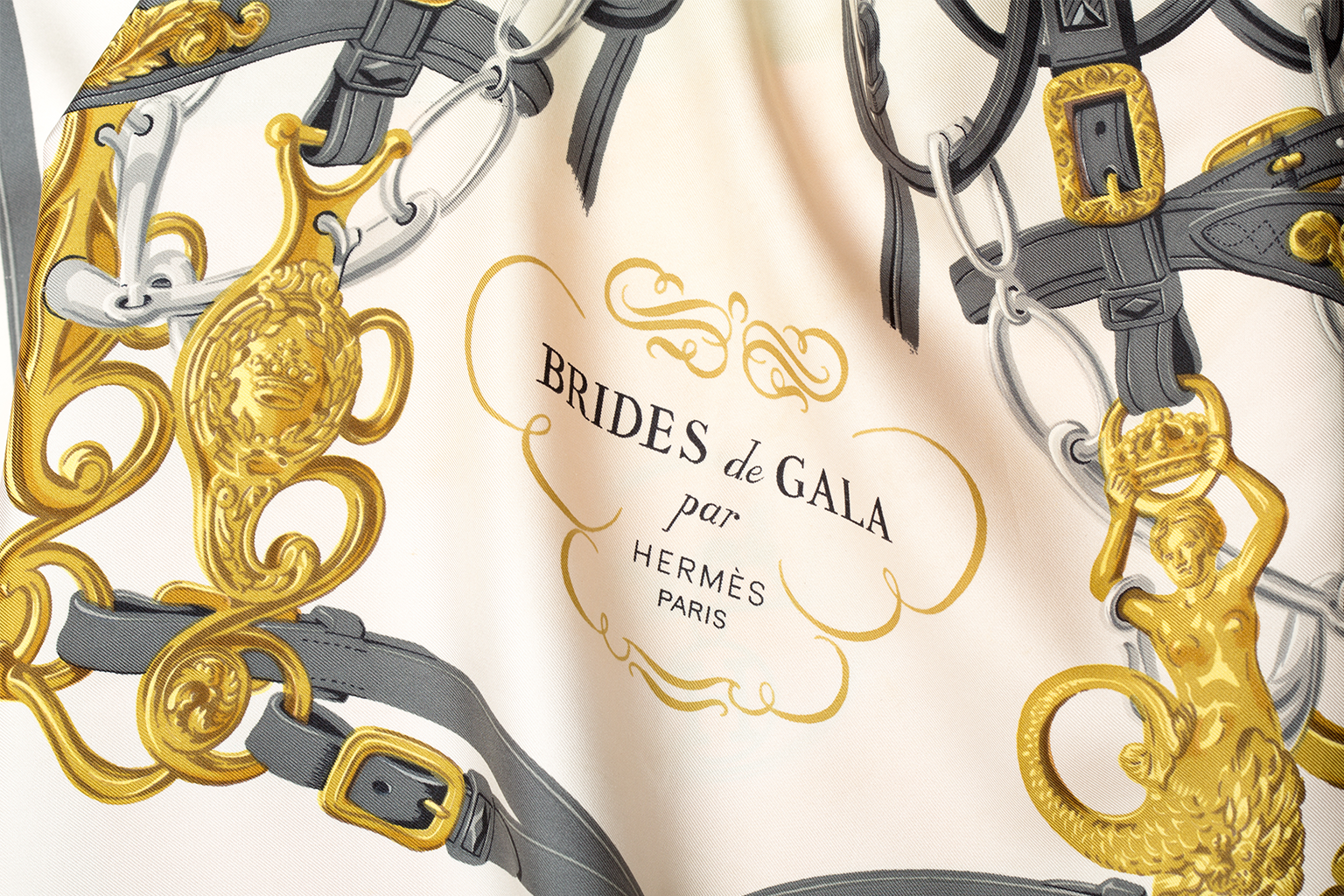
Among the most recognisable classical motifs in silk scarves are chains and equestrian references. These patterns emerged from European traditions of horsemanship, travel and aristocratic leisure. Bridles, stirrups, bits and reins became abstracted into elegant loops and interlocking forms. Chains echoed both maritime strength and ornamental jewellery, suggesting durability paired with refinement.
Visually, these motifs succeed because they balance repetition with variation. A chain pattern, when handled well, creates movement across the silk surface. It guides the eye without overwhelming it. The interplay between metallic suggestion and soft silk creates a pleasing tension, a dialogue between strength and delicacy.
From a branding perspective, equestrian and chain motifs communicate heritage and authority. They feel grounded in tradition, yet remain adaptable. Contemporary designers often soften these motifs through altered scale, unexpected colour palettes or painterly line work, ensuring they feel relevant rather than nostalgic.
Flora and fauna as living symbols
Floral and animal motifs occupy a more universal emotional register. They connect silk scarf design to the natural world, to cycles of growth, migration and seasonal change. Historically, floral patterns often reflected botanical discoveries and colonial trade routes, while animals carried symbolic meanings tied to power, protection or beauty.
In silk scarves, flora is rarely treated as mere prettiness. Leaves curl with intention. Petals are placed rhythmically. Botanical patterns often draw from scientific illustration traditions, where accuracy and elegance coexist. This gives them a timeless quality that resists fashion cycles.
Fauna introduces character. Horses, birds, cats, insects and mythical creatures each bring narrative potential. A single animal repeated across a scarf can suggest motion or mood, while a menagerie invites a more playful reading. For the wearer, these motifs offer personal resonance. They allow for emotional connection, not just aesthetic appreciation.
Nautical themes and the romance of travel
Nautical motifs emerged alongside global trade and exploration. Ropes, anchors, compasses and maps found their way into silk scarf patterns as symbols of movement and possibility. These designs speak to the romance of travel, the precision of navigation and the poetry of the sea.
What makes nautical patterns enduring is their graphic clarity. Ropes form strong lines. Compasses create natural centres. Maps lend themselves to layered detail. On silk, these elements gain fluidity, softening their technical origins. Modern interpretations often abstract nautical references, hinting rather than declaring, allowing the wearer to complete the story.
From a cultural standpoint, nautical scarves reflect a period when luxury was closely tied to global awareness. They celebrate curiosity and confidence, qualities that continue to resonate with contemporary audiences seeking meaning beyond surface beauty.
Paisley and the journey of pattern
Paisley stands apart as a motif defined by migration. Originating in Persian and Indian textile traditions, the paisley form travelled through trade routes into European fashion, where it was embraced, adapted and reinterpreted. Its distinctive teardrop shape, often filled with intricate internal patterning, symbolises abundance, growth and continuity.
In silk scarves, paisley rewards close inspection. Its complexity invites slower looking. Each curve contains smaller narratives. Designers today often play with paisley by enlarging it, fragmenting it or simplifying its interior detail. These approaches honour the motif’s history while allowing it to speak in a contemporary visual language.
Paisley’s endurance highlights a broader truth about silk scarf patterns. The most powerful motifs are those that can absorb reinterpretation without losing their essence.
Geometry and modern abstraction
Geometric patterns represent a more modern approach to silk scarf design, yet their roots are ancient. Geometry has always offered a way to express order, harmony and intellectual clarity. In scarves, geometry often appears through grids, tessellations, stripes and repeated shapes.
What distinguishes successful geometric scarves is subtle irregularity. Slight shifts in line weight, colour variation or spacing prevent rigidity. Silk’s natural sheen further softens geometry, introducing light and movement.
From a branding perspective, geometric patterns often appeal to wearers who value restraint and modernity. They suggest confidence without ornament. Increasingly, designers blend geometric frameworks with organic elements, creating hybrid patterns that feel both structured and expressive.
Colour, craft and the art of print
Pattern cannot be separated from colour. In silk scarves, colour choice defines mood, hierarchy and legibility. Historically, dye availability shaped palettes. Today, designers enjoy broader freedom, yet the principles remain. Contrast must be considered. Harmony must be earned.
Print techniques also influence pattern expression. Screen printing, digital printing and hand-drawn illustration each leave distinct traces. Slight imperfections in line or colour registration often enhance a scarf’s character, reminding the wearer of human involvement. In luxury contexts, these nuances are not flaws but signatures of craft.
Limited production runs further elevate pattern value. When a design is not endlessly replicated, it gains collectable status. The pattern becomes part of a moment, a specific creative decision preserved in silk.
Contemporary reinterpretations and future directions
Today’s silk scarf designers operate with deep awareness of history, yet they are unafraid to challenge it. Classical motifs are deconstructed, layered or paired with unexpected themes. Borders dissolve. Centres shift. Patterns become more conversational, less prescriptive.
There is also a renewed emphasis on narrative. Scarves increasingly tell specific stories, drawing on poetry, place or personal memory. This aligns with broader consumer desire for authenticity and meaning. In this context, pattern is not just visual. It is conceptual.
Sustainability considerations are also shaping pattern design. Thoughtful use of colour, reduced waste printing methods and timeless aesthetics encourage longer ownership. A well-designed pattern invites repeated wear, season after season.
The enduring power of pattern
Silk scarf patterns endure because they operate on multiple levels at once. They are visually engaging, culturally rich and emotionally resonant. They reward knowledge without requiring it. They offer both familiarity and discovery.
In an era of fast fashion and visual overload, the silk scarf remains a quiet assertion of value. Its patterns are not loud, but they are articulate. They speak of time taken, of ideas considered, of beauty that unfolds gradually.
For those who see fashion as an extension of art and intellect, silk scarf patterns continue to offer one of the most refined forms of expression available. They are not simply worn. They are read, interpreted and remembered.