
The Evolution of the Square: A Century of Design, Style and Craft
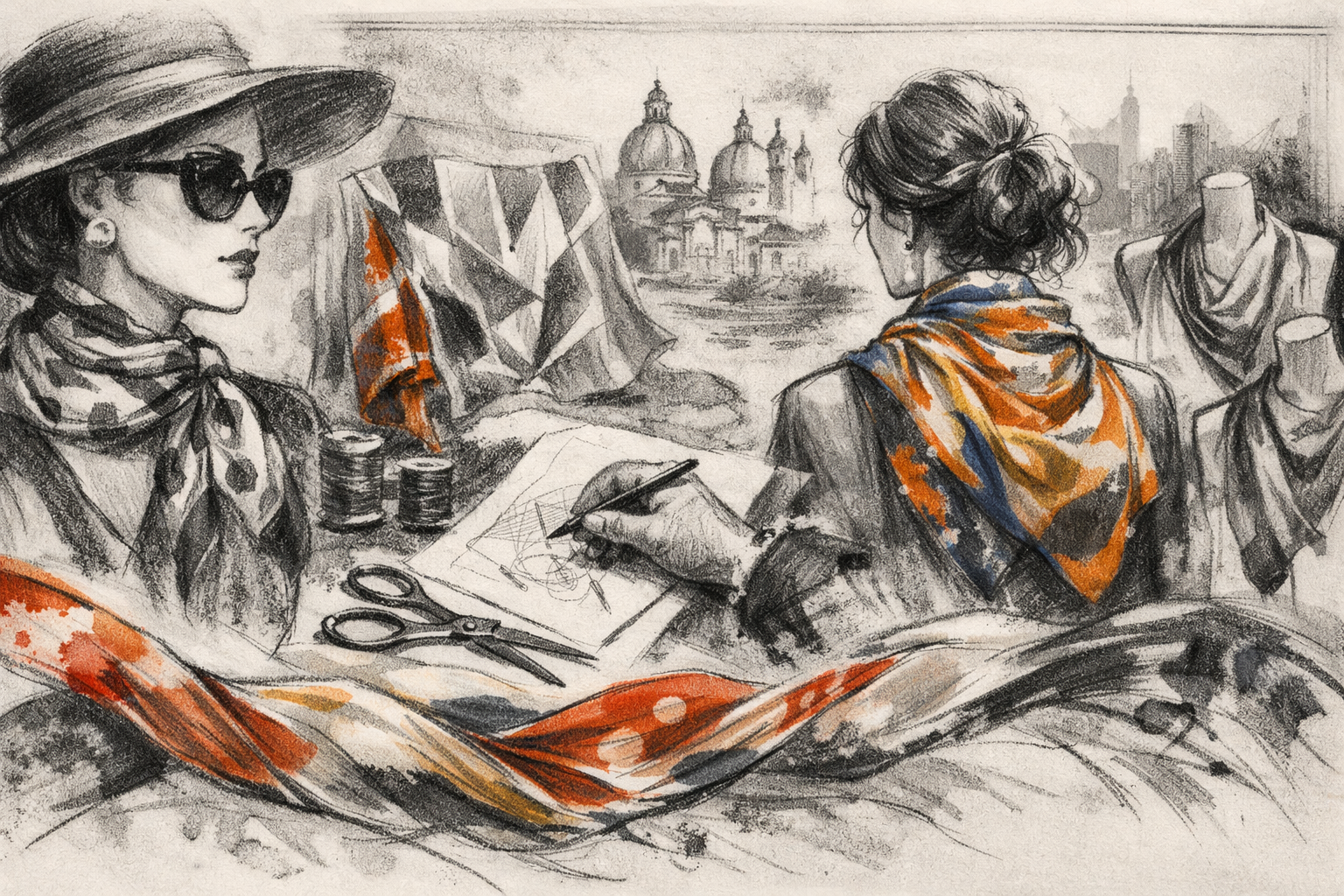
How the silk scarf became fashion’s most enduring canvas
The square is one of the simplest shapes known to us. Four equal sides. Four corners. A geometry so familiar that it almost disappears from view. And yet, in fashion, few forms have carried as much cultural weight, artistic ambition and commercial intelligence as the silk square. For over a century, the square silk scarf has sat at the intersection of art and utility, luxury and everyday life. Folded, knotted, draped or framed, it has quietly reflected the changing values of style, craftsmanship and identity.
This is not merely a story about an accessory. It is a story about how design evolves without abandoning its core. About how a fixed format can become endlessly expressive. And about how the square, disciplined and balanced, became the perfect stage for fashion houses, artists and wearers to say something lasting.
From necessity to refinement
Before the silk square became a symbol of elegance, scarves served a practical purpose. They were used for warmth, protection and identification long before they were objects of beauty. It was only in the late nineteenth and early twentieth centuries, as silk production became more refined and global trade expanded, that the scarf began its transition from utility to luxury.
Silk, with its natural sheen and strength, was the ideal medium. It accepted colour with clarity, held line with precision, and moved fluidly with the body. The square format emerged not by accident but by logic. A square could be folded symmetrically, printed efficiently, and worn in multiple ways without distorting the design. For early makers, it offered both aesthetic control and commercial sense.
By the early twentieth century, the silk square had become associated with travel, leisure and modernity. It appeared in the wardrobes of women who were increasingly mobile and visible in public life. Worn at the neck, tied in the hair, or tucked into a coat, the square became a quiet marker of taste.
The rise of the printed square
The true evolution of the square accelerated when printing techniques improved. Advances in screen printing and dye technology allowed for greater complexity, sharper detail and richer colour. Suddenly, the square was no longer just an accessory. It was a portable artwork.
Designers began to treat the surface of the scarf as a canvas. Motifs were carefully composed to work from every angle, anticipating how the scarf would be folded and revealed in fragments. Borders became significant, framing the design and anchoring the composition. Centres carried narrative, symbolism or pattern, often inspired by art, history, equestrian culture or the natural world.
This period marked a crucial shift. The value of a silk square was no longer defined solely by the quality of the silk, but by the intelligence of the design. A well designed square rewarded repeat wear. Each knot revealed something new. This interplay between concealment and disclosure became part of the allure.
Mid century modernity and graphic confidence
As the twentieth century progressed, the square evolved alongside broader design movements. Mid century modernism brought bolder graphics, cleaner lines and a more confident use of colour. The silk square mirrored this shift. Patterns became more abstract. Geometry, symmetry and repetition took centre stage.
This was also the era when branding became more deliberate. Scarves were no longer anonymous objects of beauty. They carried signatures, visual languages and recognisable styles. The square format proved ideal for this. Its consistency allowed brands to experiment creatively while maintaining coherence across collections.
Importantly, the square also became democratic. While rooted in luxury, it was increasingly visible in everyday life. It appeared in cinema, advertising and street style. It crossed boundaries of age and class, worn by women and men, styled formally or casually. The square did not demand attention, but it always rewarded it.
Craft as a quiet differentiator
As fashion accelerated towards the end of the twentieth century, the silk square took on a new role. In an era of mass production and fleeting trends, craftsmanship became a point of distinction. The square, with its defined edges and visible finishing, made quality immediately apparent.
Hand rolled hems, a traditional technique requiring precision and time, became a marker of excellence. The weight of the silk, often measured in momme, signalled durability and drape. Printing methods revealed their integrity over time. A well made square aged gracefully, its colours softening rather than fading, its fabric retaining structure.
For discerning consumers, these details mattered. The square became an object to collect, not consume. Its longevity offered reassurance. In branding terms, it communicated values of care, restraint and respect for craft.
The square in contemporary culture
Today, the silk square occupies a fascinating position. It is both classic and current. In a fashion landscape increasingly concerned with sustainability and meaning, the square offers a compelling proposition.
Its versatility reduces the need for excess. One square can be worn dozens of ways, across seasons and contexts. Its durability encourages long term ownership rather than disposable consumption. Its format supports storytelling, allowing brands to express identity through art rather than logos alone.
Contemporary designers have embraced this potential. Some collaborate with artists and illustrators, transforming the square into a limited edition print. Others revisit archival motifs, reinterpreting them for a modern audience. Colour palettes shift subtly with the times, but the underlying structure remains reassuringly familiar.
The square has also found renewed relevance beyond the neck. It appears as a headscarf, a belt, a bag accent, even framed as wall art. This adaptability speaks to a broader cultural desire for objects that are both beautiful and useful.
Marketing, meaning and modern luxury
From a branding perspective, the square silk scarf is unusually powerful. It is immediately recognisable, yet infinitely flexible. It allows a brand to demonstrate artistry without shouting. It invites emotional connection through narrative and design.
In a digital age, the square also performs well visually. Its symmetry and clarity translate across screens, from editorial photography to social media. Details can be explored up close. Styling ideas can be shared endlessly. The square becomes a bridge between heritage and modern communication.
Crucially, it supports the idea of luxury as something considered rather than ostentatious. The square does not chase novelty. It evolves quietly, carrying forward a century of design intelligence.
Why the square endures
What makes the square so enduring is not nostalgia. It is balance. The balance between form and freedom, between discipline and expression. Designers know its constraints and work creatively within them. Wearers trust its versatility and return to it repeatedly.
In a world that often values speed over substance, the square silk scarf reminds us that refinement takes time. That good design does not need to reinvent itself to remain relevant. Sometimes, the most powerful evolution happens within a fixed frame.
The square endures because it understands something fundamental about style. That elegance is rarely loud. That confidence is often quiet. And that craft, when done well, speaks for itself.