
How to Store Silk Scarves: A Considered Guide to the Drawer, the Box and the Fold
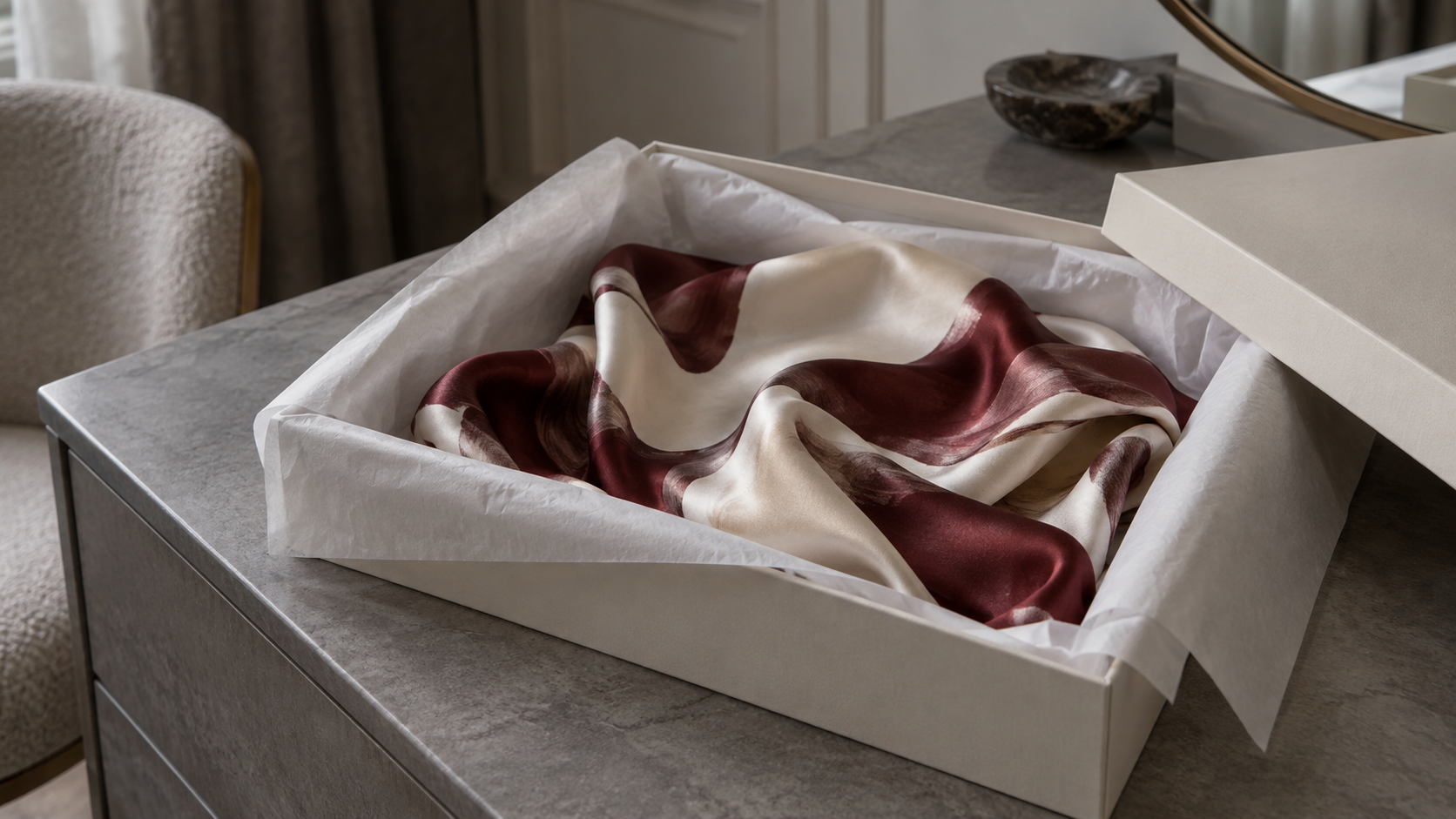
AI-generated editorial illustration of scarf storage; materials and construction shown are illustrative, not a tested product recommendation.
The best place for a silk scarf is neither a crowded drawer nor a permanent display. Good storage gives the cloth support and protection while keeping the pieces you love accessible enough to wear.
A scarf drawer should not require an excavation. If finding one square means pulling three others from beneath a stack, the arrangement is working against both the cloth and its owner. Equally, a row of scarves left permanently on show may make an attractive room while providing the wrong conditions for keeping their colours.
The useful distinction is between a scarf in regular rotation and a fragile piece being preserved. Both deserve care, but they do not necessarily need the same storage system. Begin with the condition of the textile and its own care instructions, then choose an arrangement you can maintain without ceremony.
What is the best way to store silk scarves?
For most sound silk squares, use a clean, covered drawer or suitable box, with the cloth supported and folding kept to a minimum. If folds are necessary, keep them loose and supported rather than pressed into tight edges. Protect stored silk from light and damp, and separate fragile vintage pieces from everyday accessories. These are general principles, not instructions to wash, iron or restore an unfamiliar scarf.
Let the product’s instructions come first
A silk label identifies a fibre, not a universal cleaning procedure. On its Flagship scarf 90 listing, for example, Hermès advises storage flat and untied, avoidance of water and chemicals, and professional dry cleaning when needed. That is guidance for the specified product; it should not be expanded into a claim that every silk scarf requires identical treatment. Keep the care information supplied with your own piece. Read the Hermès care example.
Make a habit of checking a scarf before returning it to its place. A loose hem, a newly noticed mark or an unfamiliar change in the surface deserves attention before the piece disappears for a season. If cleaning is needed, our guide to washing and professional cleaning explains why the care label and the behaviour of the dyes matter more than the word silk alone.
The drawer: support without compression
The Canadian Conservation Institute recommends flat storage because it supports a textile across its surface. Its guidance calls for a suitable lining, minimal folding and padding within unavoidable folds; it also advises against stacking where possible, since the accumulated weight can damage lower layers. For a small wardrobe collection, this suggests a shallow arrangement with enough room to lift each scarf without dragging it past its neighbours. CCI guidance on flat storage.
Measure the usable space before choosing a box or organiser. Consider the width of the opening as well as the interior: a container can be large enough to hold a scarf and still awkward to reach into. Our preference is for fewer pieces in each layer, with the colours visible at a glance. Leave jewellery, belts and other hard accessories in a separate compartment.
The box: distinguish packaging from preservation
A presentation box may be worth retaining as part of a scarf’s history, but its branding does not establish the suitability of its board, lining or tissue for long-term contact. CCI advises retaining original packaging separately where appropriate and using storage materials selected for their compatibility with textiles. An acid-free conservation box is one option; a handsome retail box is not automatically the same thing.
For tissue that touches silk, look specifically for unbuffered, acid-free material. CCI’s rolled-storage guidance explains that buffered papers contain alkaline substances that can harm protein fibres, including silk, and some dyes. The distinction is easy to miss when buying supplies: acid-free and unbuffered describe different properties, and the first word does not guarantee the second. CCI’s explanation of tissue and silk.
Should a silk scarf be rolled?
Proper rolled storage is not the same as curling a scarf into a small unsupported bundle. CCI describes rolling suitable flat textiles around a prepared support tube, with appropriate interleaving and a protective cover; the textile should not first be folded to reduce its width. Very weak pieces, loose components and stiff decoration can make rolling unsuitable. For an important vintage scarf, ask a conservator which method fits its condition rather than assuming that rolling is always gentler.
There is also a question of use. A carefully supported roll may suit a piece accessed infrequently, but be cumbersome for something worn several times a week. Our editorial preference for a sound everyday square is a straightforward, spacious system that encourages the owner to put it away properly, rather than a complicated arrangement that is soon abandoned.
Why darkness matters between outings
Light can fade colour and weaken textile fibres, and the damage is cumulative and irreversible. CCI stresses that both the intensity and duration of exposure matter; reducing ultraviolet radiation alone does not eliminate damage from visible light. A scarf hung beside a window is therefore on display, not protected simply because it is indoors. A closed drawer or cupboard allows it to rest out of the light between occasions of use. CCI guidance on textiles and their environment.
The same guidance identifies damp as a significant threat because it can encourage mould and other deterioration. Avoid treating an attic, cellar or steamy bathroom as an equivalent substitute for a dry wardrobe space. Where a room has persistent damp, changing the box will not resolve the underlying problem.
A collection needs a small amount of record-keeping
Photograph each scarf open, then record its name if known, dimensions, purchase details and any condition issues. Keep receipts and notes where you can find them without repeatedly unfolding delicate cloth. This is useful even for a collection of three: the information belongs to the object’s history, and an unlabelled photograph may become surprisingly difficult to identify years later.
When planning the arrangement, start with the piece that needs most care rather than the one worn most often. A fragile inherited square should not become the bottom layer simply because it is seldom used. Our guide to scarf sizes helps with planning space, but condition should decide how much handling a particular piece can tolerate.
Make care part of wearing
A good storage arrangement should make the collection more inviting, not turn it into a collection of untouchable packages. Keep the pieces in regular use easy to locate, give delicate examples their own support, and retain enough information to recognise a change when you inspect them. The aim is a considered balance: protect the cloth between outings without forgetting why you wanted to wear it.
Questions about storing silk scarves
Can I leave a scarf tied to a handbag?
A tied scarf is in use rather than at rest. Remove it for storage and follow its care guidance; the Hermès example above explicitly recommends storing the scarf untied.
Is all acid-free tissue suitable for silk?
No. Check that it is also unbuffered, rather than assuming that every paper described as acid-free is appropriate for direct contact with silk.
Should I iron a vintage scarf before putting it away?
Do not make ironing a compulsory preparation step. Follow the care instructions, and seek specialist advice before applying heat or moisture to an old, weakened or unfamiliar textile.
What should I do if I suspect mould or insects?
Keep the affected piece apart from the rest of the collection and obtain specialist advice. Do not treat an ordinary wardrobe-storage guide as a procedure for cleaning or treating an infestation.
Sources and editorial notes
Researched on 15 September 2026 using the Canadian Conservation Institute’s flat-storage, rolled-storage and environmental guidance, together with the product-specific Hermès care example linked above. Museum guidance has been interpreted for a domestic readership, not presented as a personal conservation assessment. Fragile, damaged or historically important textiles may require individual advice from a qualified conservator.