
What Makes a High-Quality Silk Scarf? A Complete Guide to Silk, Momme, Weave and Finish
A high-quality silk scarf is not defined by one impressive-sounding phrase on its label. “Mulberry silk”, “high momme”, “hand-finished” and even “100% silk” each describe only one part of the object. Two scarves can carry the same fibre description and still differ considerably in weight, texture, colour, construction, durability and the way they sit when tied.
The strongest silk scarves are the result of several elements working together: the quality and type of silk, the construction of the yarn, the fabric weight, the weave, the printing or dyeing process, and the standard of the final finishing. No single number or material claim can provide a complete verdict.
In Brief
Silk scarf quality depends on fibre, yarn, weave, weight, printing and finishing working together.
Momme measures the weight of silk fabric. It is not a universal score of craftsmanship or quality.
Mulberry silk can produce fine, relatively consistent continuous filaments, but the term alone does not prove that a finished scarf is well made.
Twill, satin, chiffon, crepe and habotai are different fabrics with different purposes. A lighter or softer scarf is not necessarily inferior.
Hand-rolled edges demonstrate labour and skill, but they cannot compensate for weak fabric, poor printing or unstable colour.
The best scarf is not always the heaviest one. Its material and construction should suit its dimensions, design and intended use.
Why “100% Silk” Does Not Tell the Whole Story
A fibre label answers one basic question: what is the scarf made from? It does not explain how the silk was produced, whether the yarn is reeled or spun, how evenly it was woven, how much fabric is present, whether the colours are stable, or how carefully the edges were finished.
Silk is an animal protein fibre. In commercial mulberry sericulture, the domesticated silkworm Bombyx mori produces a cocoon filament composed principally of fibroin surrounded by sericin, a gum-like protein. During reeling, filaments from several cocoons are combined to form a usable raw-silk thread. Subsequent degumming removes some or most of the sericin and changes the handle, lustre, absorbency and dyeing behaviour of the material.
This means that “silk” is only the beginning of the description. A buyer assessing a scarf should also consider how that silk became yarn, how the yarn became fabric, how the fabric received colour and how the finished square was cut and hemmed.
What Is Mulberry Silk?
Mulberry silk is produced by Bombyx mori silkworms reared on mulberry leaves. It is the principal silk used in commercial textile production and is often the material people mean when they refer simply to silk.
Its widespread use is partly connected to the domesticated silkworm’s ability to produce fine, reelable cocoon filaments suitable for relatively smooth and consistent yarn. This makes mulberry silk particularly useful for detailed printed scarves, where the surface of the cloth needs to reproduce lines, colour fields and fine artwork with clarity.
Mulberry silk is a valuable material, but its name should not be treated as a certificate of finished quality. A poorly woven or carelessly printed mulberry-silk scarf can still be inferior to a thoughtfully produced scarf made from another silk tradition.
Tasar, muga and eri silks have different colours, textures and production characteristics. Some are less uniform than conventional mulberry silk, but irregularity is not always a defect. It may be intrinsic to the material and deliberately retained for its visual and tactile character.
The question is not whether every scarf resembles smooth mulberry twill. It is whether the chosen silk has been used intelligently and appropriately.
Reeled Silk and Spun Silk Are Not the Same
One of the most useful distinctions is between filament silk and spun silk.
A reelable cocoon can produce a long, continuous filament. Several extremely fine filaments are brought together during reeling to create a raw-silk thread. This continuous structure allows the yarn to produce a smooth, lustrous and relatively even fabric surface.
Not all silk can be reeled as a continuous filament. Pierced cocoons, broken fibres and material left from the reeling process can be cleaned, carded and combed into shorter staple fibres. These are spun into yarn through a process more comparable to the production of wool or cotton yarn. Longer recovered fibres may become spun silk, while shorter fibres can be used for silk noil.
Filament silk generally creates a smoother, more reflective and more continuous surface. Spun silk tends to appear softer, less glossy and slightly more fibrous.
Neither description automatically means good or bad. Filament silk is often preferred for crisply printed silk squares, while spun silk may be entirely suitable for warmer, softer or more textured scarves. Problems arise when these important differences are hidden behind broad phrases such as “pure silk” without any further explanation.
What Does Momme Mean?
Momme, usually abbreviated to mm, is a traditional measurement of silk fabric weight. It refers to the number of pounds that a piece of fabric measuring 45 inches by 100 yards would weigh.
One momme is approximately equal to 4.34 grams per square metre.
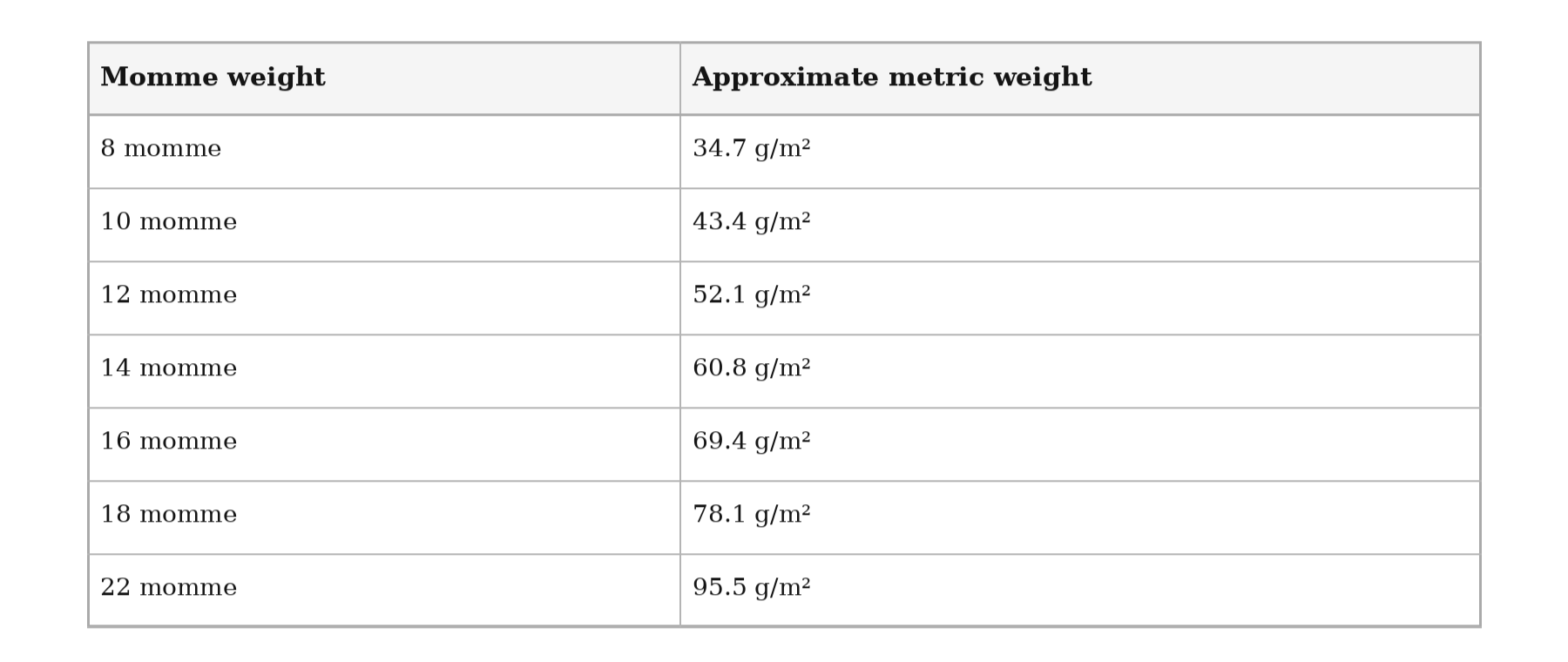
Momme tells a buyer how much the fabric weighs relative to its area. Within otherwise comparable fabrics, a higher momme usually indicates that the cloth is heavier and may be denser or more substantial.
It does not reveal the quality of the original filament, the evenness of the yarn, the skill of the weaving, the accuracy of the print or the standard of the finishing. A badly finished 22-momme scarf does not become superior simply because it contains more material. Equally, an intentionally light chiffon scarf should not be condemned for having a lower momme than a structured twill square.
Is a Higher Momme Always Better?
No. The appropriate momme depends on the weave, dimensions and intended behaviour of the scarf.
A large scarf may need enough weight to fall cleanly without becoming cumbersome. A small neckerchief may need lightness so that it can be folded and knotted without producing a bulky centre. A chiffon scarf relies on transparency and movement, while a classic twill square benefits from enough substance to hold a fold.
Momme becomes most useful when comparing two fabrics of a similar weave and intended function. Comparing a 16-momme twill with an 8-momme chiffon as though they were competing versions of the same material misunderstands both fabrics.
Silk Grades and the Problem With Impressive Letters
Silk grading is more complicated than many consumer descriptions suggest.
Technical raw-silk classification can evaluate characteristics such as size consistency, cleanliness, neatness, strength, elongation, cohesion and winding performance. The International Sericultural Commission describes raw-silk grades in the order 4A, 3A, 2A, A and B.
These grades concern raw silk and testing systems, not the complete quality of a finished scarf. Other national, industrial or supplier-specific systems may use different classifications.
A consumer-facing claim such as “Grade A” or “6A silk” is therefore incomplete unless the seller identifies the standard being used, the material being graded and the tests behind the result. A raw-material grade cannot describe the artwork, weave, print registration, colour fastness, edge construction or final inspection of the completed piece.
The largest number of As does not automatically identify the best scarf.
Why the Weave Matters as Much as the Fibre
Silk is a fibre. Twill, satin and plain weave describe ways of arranging yarns into fabric. Crepe describes a textured construction that may be produced through highly twisted yarns or particular weave structures. Chiffon, habotai and organza describe recognisable fabric types with their own combinations of yarn, weave, weight and finish.
The three fundamental woven structures are plain, twill and satin.
Plain weave alternates warp and weft yarns in a regular over-and-under sequence. Twill creates a diagonal structure by shifting the interlacing points across the cloth. Satin uses longer floats, allowing one set of yarns to dominate the surface and produce a smoother, more reflective face.
Common Silk Scarf Fabrics
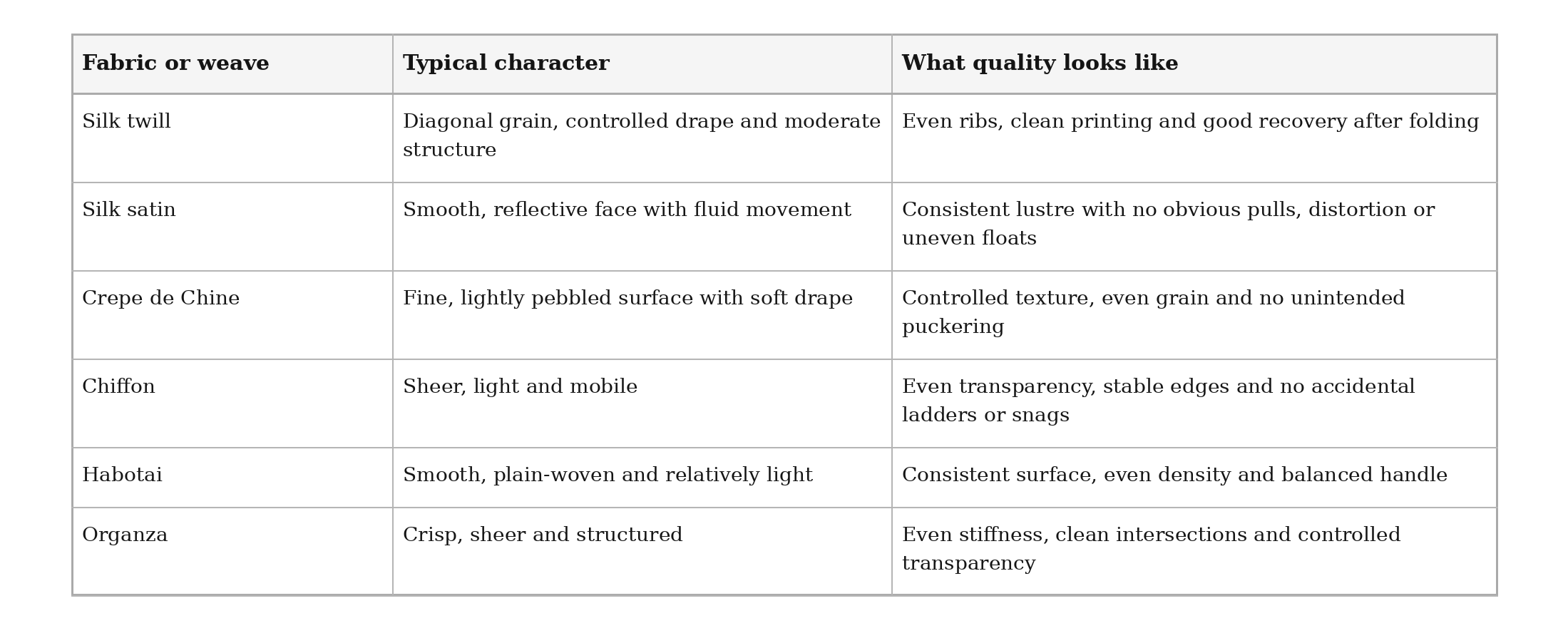
Twill is closely associated with printed silk squares because its diagonal construction can provide a useful balance of durability, body and drape. Satin offers stronger surface shine and fluidity but may be more vulnerable to visible snagging because of its longer floats.
Plain-woven silks can range from soft habotai to crisp organza, demonstrating why weave name, weight and finishing must be considered together.
A scarf does not need to use twill to be of high quality. The weave must simply serve the object. A successful chiffon scarf should not behave like a heavy twill, just as a structured printed square should not collapse like loose gauze.
Silk and Satin Are Not Interchangeable Terms
Silk and satin are frequently used as though they describe rival materials. They do not.
Silk identifies the fibre. Satin identifies a weave structure and the smooth fabric associated with it. Satin can be woven from silk, polyester, viscose or other fibres. A product described only as satin is not necessarily made from silk.
Conversely, not all silk is satin. Silk can be woven into twill, plain weave, crepe, organza, velvet and many other constructions. The most accurate description combines fibre and construction, such as “100% silk twill” or “silk satin”.
This distinction is important because a scarf can feel glossy and smooth while being made from synthetic satin. A genuine silk twill may have a quieter, more textured surface and still be the more valuable or carefully made object.
How Printing Affects Silk Scarf Quality
A printed scarf should be judged not simply by whether its colours appear bright, but by how successfully the design has been transferred to the chosen cloth.
Traditional screen printing separates a design into colours and applies them through individual screens. Digital textile printing sends the design to specialist equipment without requiring a separate physical screen for every colour.
Neither method is automatically superior. Screen printing can offer exceptional control and colour depth, while digital printing can reproduce intricate tonal transitions and highly complex artwork without requiring an impractical number of screens.
The final result depends on fabric preparation, inks or dyes, fixation, washing, colour management and the structure of the silk itself. Different fabrics respond differently to the same colours, which is why careful sampling is an essential part of good textile production. A V&A Dundee account of producing patterned silk scarves describes repeated sampling and adjustment to achieve the intended colour on silk crepe de Chine.
A colour that appears one way on paper or a computer screen may behave very differently once it enters silk.
What Should a Good Print Look Like?
Look for controlled edges to motifs, accurate registration where colours meet, consistent colour across uninterrupted areas, and fine details that have not filled in or broken apart.
Large colour fields should not show unexplained streaking, accidental marks or mechanical banding. The image should feel integrated with the cloth rather than appearing as a brittle layer sitting on its surface.
The reverse of the scarf should also be examined, although it does not need to look identical to the front. Some printing methods produce deeper penetration than others, and some scarves are deliberately engineered with separate designs or colours on each face.
Hermès, for example, produces double-face silk twill scarves on which both sides are intentionally printed as distinct surfaces. This demonstrates why a scarf’s reverse must be judged according to the intended production method rather than against a universal rule.
A pale reverse is not automatically evidence of poor quality. The important question is whether the result is intentional, technically controlled and appropriate for the design.
Colour Fastness Matters More Than Immediate Brightness
A scarf can look impressive when new and still perform poorly over time. Textile colour may be affected by light, water, perspiration, friction, cleaning agents, perfume and cosmetics.
Manufacturers should conduct appropriate testing for their dyes, inks and finished fabric, although consumers will not always have access to the results. Warning signs include colour transferring onto a clean, slightly damp white cloth, fading around folds after limited use, or clear differences between areas that should have been printed consistently.
Silk is also vulnerable to prolonged light exposure. The Canadian Conservation Institute identifies silk as particularly light-sensitive and advises that textiles should be protected from light, pollutants, unsuitable humidity, pests and damaging storage conditions.
This does not mean that a silk scarf should never be worn or displayed. It means that colour stability and future care are part of quality, particularly for collectable or artist-designed pieces.
The Importance of Degumming and Finishing
Raw silk contains sericin around the fibroin filaments. Degumming removes this gum to varying degrees, producing a softer and more absorbent material.
The exact process can influence handle, strength, dye behaviour and surface smoothness. Different degumming treatments may alter gum loss, wetting, colour yield and the amount of strength retained by the finished fibre.
This helps explain why two scarves made from nominally similar silk may not feel the same. One may have a clean, supple handle, while another feels harsh, waxy, excessively limp or artificially coated.
Finishing can include washing, softening, calendaring, steaming and other mechanical or chemical treatments. These processes are normal parts of textile production and are not inherently deceptive.
The issue is whether they improve the material without disguising weak fabric or producing a surface that deteriorates quickly. A good finish should feel integrated with the cloth. The scarf should not have a brittle glaze, excessive chemical odour, greasy residue or inconsistent stiffness unless a particular artistic effect clearly requires it.
Are Hand-Rolled Edges a Sign of Quality?
A hand-rolled hem is created by rolling the cut edge into a narrow tube and securing it with hand stitches. It is labour-intensive and can give a silk scarf a soft, rounded frame without the flatter appearance of a conventional machine hem.
Subtle variation is normal because the edge is made by hand. The roll should nevertheless remain controlled, the stitches should be secure and the fabric should not be pulled so tightly that the border puckers.
Corners require particular care because excess material must be managed without creating a large, hard lump. Hand-rolling can also produce small variations in the final dimensions of a scarf. Hermès notes on its product pages that the dimensions of hand-rolled scarves may vary, illustrating that a slight dimensional difference can result from manual finishing rather than poor control.
A hand-rolled edge is valuable evidence of work, but it should not be treated as final proof of quality. A hand-sewn hem cannot rescue inferior silk, weak printing or a badly distorted square.
Conversely, a precisely executed machine finish may be entirely appropriate for a modern scarf designed around clean, narrow edges or a particular price point. The correct question is not simply whether the hem was made by hand. It is whether the edge was chosen and executed well.
How to Inspect a Silk Scarf in Person
Begin by laying the scarf on a clean, flat surface. Check whether the square or rectangle appears balanced. A soft woven fabric will never behave like a sheet of rigid paper, but the sides should not twist conspicuously or pull in conflicting directions.
Hold the scarf up to gentle natural light. The weave should look consistent unless the design intentionally uses areas of different density. Look for holes, snags, thick knots, pulled threads and irregular bands.
Small natural variations may occur, particularly in handwoven or textured silk, but repeated defects or unexplained changes in density can indicate weak production control.
Run the fabric lightly through clean fingers. Quality silk should feel coherent. It may be crisp, dry, pebbled, smooth or fluid depending on its weave, but it should not feel as though the surface and underlying structure belong to different materials.
Fold the scarf loosely and allow it to fall. Good drape is not the same as maximum softness. The cloth should move in a way appropriate to its weight. A twill square should form controlled folds, while chiffon should remain light and mobile.
Examine the design at close range. Fine lines should remain intentional. Large colour fields should not show accidental banding. Borders should align with the cut and hem unless deliberate asymmetry is part of the artwork.
Finally, inspect the reverse. It does not need to be identical to the front, but it should reveal a coherent production method rather than unexplained inconsistency.
What Does Not Reliably Prove Quality?
A High Price
Price may reflect design, scarcity, labour, distribution, branding, packaging and artistic reputation. It can accompany excellent construction, but it is not a material test.
A Famous Name
Established makers may maintain demanding standards, but a logo cannot replace inspection. Vintage condition, production period and individual construction still matter.
Extreme Softness
Silk can be soft, but softness can also result from a loose weave or heavy finishing. Some exceptional silk twills have a relatively dry and structured handle.
Very High Shine
Natural silk can have a distinctive lustre, but dramatic surface shine may come from satin construction or finishing. Lustre alone does not identify fibre quality.
A High Momme Number
Momme measures fabric weight. It cannot assess design, yarn regularity, weaving, printing, dye stability or hemming.
The Words “Mulberry Silk”
Mulberry identifies the silk source. It does not describe the complete production process or finished object.
A Burn Test
Burn testing is destructive, unsafe in unsuitable settings and difficult to interpret reliably without experience. It may distinguish broad fibre categories, but it cannot establish the quality of a scarf and should not be performed on a valued object.
A Practical Silk Scarf Quality Checklist
Before buying, ask or inspect:
Fibre content: Is it described clearly as silk rather than merely satin?
Silk type: Does the seller identify mulberry, eri, tasar, muga or another silk where relevant?
Fabric construction: Is the scarf twill, satin, crepe, chiffon, habotai or another fabric?
Momme or fabric weight: Is a weight provided, and is it appropriate to the weave and intended use?
Yarn and surface: Does the fabric appear even and free from unintended defects?
Printing: Are the details, registration and colour fields controlled?
Reverse: Does it look consistent with the stated printing method?
Drape: Does the scarf move appropriately for its size and construction?
Hem: Is the edge secure, balanced and suited to the design?
Corners: Are they neatly resolved without excessive bulk or distortion?
Care information: Are realistic cleaning and storage instructions supplied?
Transparency: Does the maker explain where and how the scarf was produced without relying entirely on vague luxury language?
No single answer determines quality. Together, these details reveal how much thought and control have gone into the finished scarf.
Frequently Asked Questions
What Is the Best Type of Silk for a Scarf?
There is no single best silk for every scarf. Smooth reeled mulberry silk is particularly suitable for detailed printed twill and satin scarves because it can provide a fine, relatively consistent surface. Chiffon, crepe, habotai, organza, eri and tasar silks have different qualities that may be preferable for sheerness, texture, warmth or structure. The best material is the one correctly matched to the design and intended use.
What Is a Good Momme Weight for a Silk Scarf?
A suitable momme depends on the scarf’s weave, size and purpose. Light chiffon may use a much lower momme than a structured silk twill square. Medium-weight twills are often chosen for classic printed scarves because they balance drape and fold retention, but there is no universal number at which a scarf becomes high quality. Momme should only be compared between broadly similar fabrics.
Is 22-Momme Silk Better Than 16-Momme Silk?
Not necessarily. A 22-momme fabric contains more weight per unit area than a 16-momme fabric, but heavier does not automatically mean better. The 16-momme fabric may be more suitable for a small scarf or a design requiring softer folds. Fibre quality, weave, printing and finishing still need to be assessed.
Is Mulberry Silk the Highest-Quality Silk?
Mulberry silk is widely valued because Bombyx mori cocoons can produce fine, reelable filaments suited to smooth and consistent fabrics. However, the word “mulberry” does not guarantee that a scarf has been woven, printed or finished well. Other silks may be deliberately selected for their colour, texture or cultural production traditions. Quality should be judged according to the intended material rather than through one universal hierarchy.
Is Silk Twill Better Than Silk Satin?
Silk twill and silk satin behave differently. Twill usually offers a visible diagonal structure, useful body and good fold retention. Satin has a smoother, more reflective face and often a more fluid fall. Twill may be preferable for a structured printed square, while satin may suit a softer scarf where surface lustre is central. Neither weave is automatically superior.
Does a Good Silk Scarf Need a Hand-Rolled Hem?
No. A carefully hand-rolled hem can demonstrate skill and provide an attractive rounded edge, but it is only one quality indicator. Machine finishing may be appropriate when it is neat, secure and consistent with the scarf’s design. The fabric, print, colour and overall construction matter more than the prestige associated with one finishing method.
Should the Print Appear Equally Strong on Both Sides?
Not always. The appearance of the reverse depends on the fabric, dyes, inks and printing process. Some traditionally printed scarves show considerable colour penetration, while others have a clearly identifiable front. Double-face scarves may carry deliberately different prints on each side. A pale reverse is not by itself proof of poor quality. Unexplained patchiness and inconsistency are more concerning.
How Can I Tell Whether a Scarf Is Genuine Silk?
Begin with a reliable fibre-content label, transparent product information and a reputable seller. Genuine silk often has a complex rather than mirror-like lustre, but touch and appearance alone are not conclusive. Laboratory fibre analysis is more reliable than home tests. Descriptions such as “silky”, “silk feel” and “satin” do not necessarily mean that the product contains silk.
A good silk scarf is the result of a sequence of decisions. The silkworm and cocoon determine the starting material. Reeling or spinning shapes the yarn. Weaving determines the structure. Weight affects substance and movement. Printing establishes how the artwork belongs to the cloth. Washing, finishing, cutting and hemming decide how the object finally behaves in the hand.
Reducing all of that to “100% silk”, “high momme” or “hand-rolled” makes comparison easier, but not more accurate.
The strongest scarf is the one in which the material, image, weight and construction agree with one another. Quality can be seen in the absence of conflict: colour that suits the cloth, folds that hold without stiffness, an edge that frames without distorting, and a surface that still rewards examination after the first impression has passed.
Sources
Food and Agriculture Organization of the United Nations, Silk Reeling and Testing Manual
https://www.fao.org/4/x2099e/x2099e00.htm
Food and Agriculture Organization of the United Nations, Chapter 1: Silk and the Silkworm
https://www.fao.org/4/x2099e/x2099e02.htm
Food and Agriculture Organization of the United Nations, Chapter 2: Characteristics of the Cocoon
https://www.fao.org/4/x2099e/x2099e03.htm
Food and Agriculture Organization of the United Nations, Chapter 6: Raw Silk Reeling
https://www.fao.org/4/x2099e/x2099e07.htm
Food and Agriculture Organization of the United Nations, Chapter 8: Silk Waste and By-products
https://www.fao.org/4/x2099e/x2099e09.htm
International Sericultural Commission, Key Components of Silk Production and Raw-Silk Testing
https://inserco.org/en/key_components
Museum of Fine Arts Boston, CAMEO: Weaving
https://cameo.mfa.org/wiki/Weaving
Museum of Fine Arts Boston, CAMEO: Plain Weave
https://cameo.mfa.org/wiki/Plain_weave
Museum of Fine Arts Boston, CAMEO: Satin
https://cameo.mfa.org/wiki/Satin
V&A Dundee, A Uniform Approach
https://www.vam.ac.uk/dundee/articles/a-uniform-approach
Canadian Conservation Institute, Caring for Textiles and Costumes
Canadian Conservation Institute, Basic Care of Textiles
Canadian Conservation Institute, Flat Storage for Textiles
Hermès, Les Eperons Double Face Scarf 90
https://www.hermes.com/nl/en/product/les-eperons-double-face-scarf-90-H901617Sv02/
Dharma Trading Company, Momme and Silk Fabric Weight
https://www.dharmatrading.com/blogs/a/did-you-know-momme-fabric-weight