
What Is the Trend for Silk Scarves in 2026?
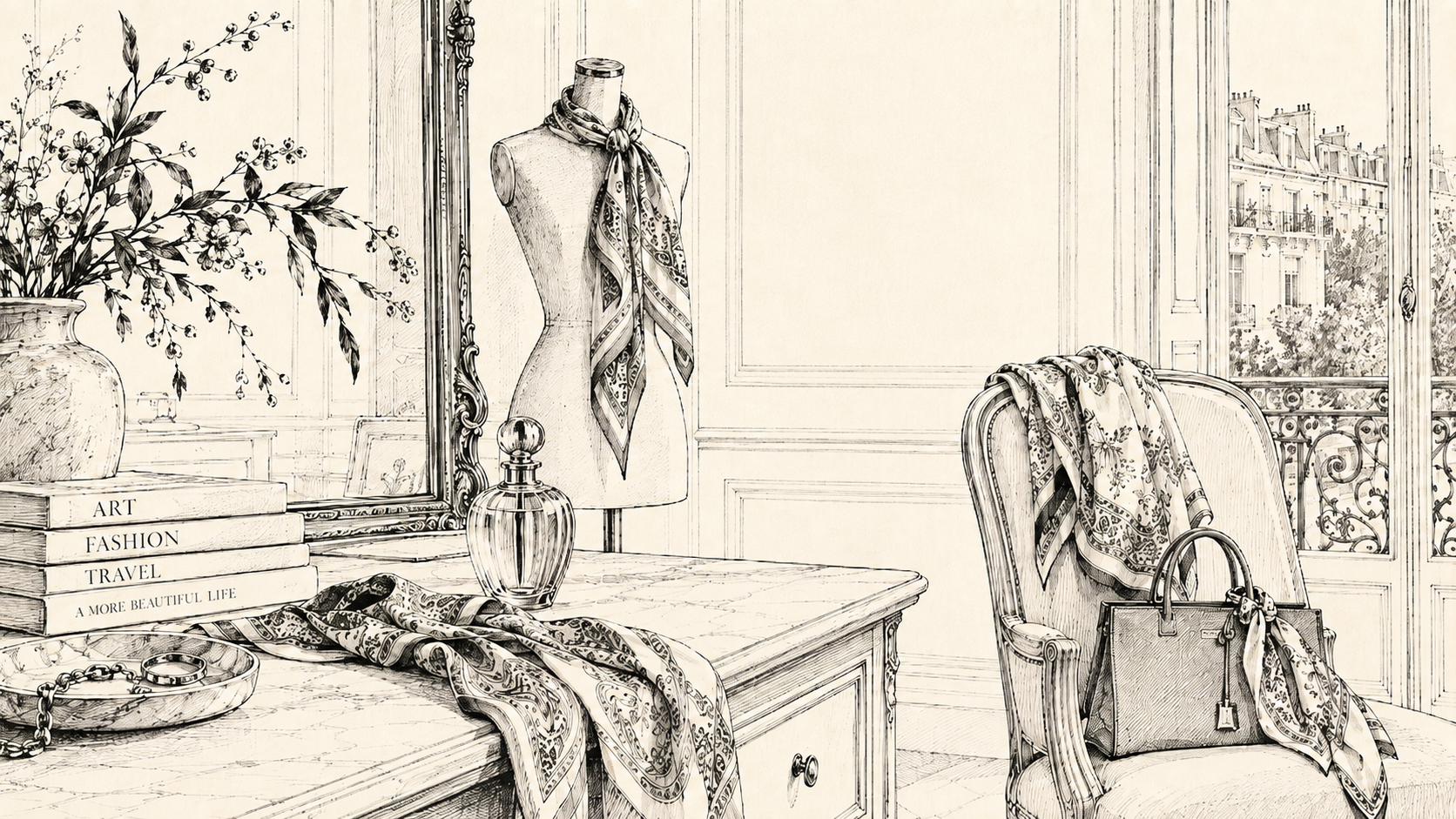
The main silk scarf trend for 2026 is what fashion editors have increasingly called “scarf dressing”: wearing silk beyond the traditional neck knot, including over the hair, around the waist, across the shoulders, on handbags and even as tops, wraps and parts of larger garments. Silk scarves featured prominently across the Spring/Summer 2026 collections and have continued into Autumn/Winter 2026, but there is no single colour, print or size dominating the trend. What defines the year instead is versatility, with the same square of silk being treated as something the wearer can continually reinterpret.
Calling this a comeback is tempting, but not quite accurate. The silk scarf never disappeared in the way that some fashion objects do. The carré remained in production, vintage scarves continued to be collected, and silk tied around the neck or hair survived perfectly well during the years in which editors happened to be more interested in other accessories. What has changed in 2026 is the scarf’s position within an outfit. Instead of arriving at the end as a decorative finishing touch, it is increasingly being used to construct the look itself, sometimes providing the colour, sometimes changing the silhouette and sometimes becoming a substantial part of the clothing.
That distinction is visible across the year’s fashion coverage. Vogue’s Spring/Summer 2026 trend report described scarves as moving from an accent to a key element of the look, with patterned silks fashioned into tops and dresses, wrapped around waists and knotted across shoulders. Its editors separately identified “scarf dressing” at Celine and Kallmeyer as one of the season’s significant ideas, while British Vogue observed silk being folded into tops, worn across the hips, placed over the hair and attached to handbags. By late summer, Vogue’s review of the trends people had actually worn included scarf accessories among the season’s successes, and its Fall 2026 coverage has since documented designers using scarves as focal points rather than merely finishing details.
Perhaps the most revealing evidence concerns not simply people searching for scarves, but what they wanted to do with them. Pinterest UK data reported by RTÉ found searches for “silk scarves” had increased by 105 per cent between November 2025 and May 2026, while searches for “silk scarf styling” rose by 425 per cent over the same period. These figures describe activity on one platform in one market rather than global sales, so they should not be treated as a measure of the entire scarf industry. What they do suggest, however, fits remarkably neatly with what designers were showing at the same time: interest was growing especially quickly around the possibilities of styling the scarf rather than simply purchasing one.
Why “scarf dressing” is the real trend of 2026
Most fashion trends provide relatively clear instructions. Trousers widen, skirts shorten, a shoe acquires a particular toe or one colour begins appearing often enough to become recognisable as the shade of the season. The silk scarf trend of 2026 is unusual because its defining characteristic is almost the opposite. Fashion has not settled upon one approved scarf and instructed everybody to wear it in the same way. Instead, designers and wearers have become interested in the scarf because there are so many different things it can become.
That quality is built into the object itself. A square of silk folded diagonally can cover the hair, while another few folds reduce it to a narrow strip around the neck. Open the same scarf again and, if it is sufficiently large, it can be wrapped across the shoulders, knotted at the waist or fashioned into a simple top. It can pass through belt loops, sit beneath tailoring, become a loose layer over trousers or never touch the body at all, instead appearing around a handbag handle. Nothing has been permanently altered, yet each treatment exposes different corners, borders and parts of the illustration, making the same design appear surprisingly different.
The Spring 2026 collections made precisely this versatility visible. Kallmeyer demonstrated that scarf dressing need not belong exclusively to beaches and holidays by combining silk with tailored trousers and jackets, while other runway treatments pushed scarves towards halter tops, belts and layered pieces. Vogue’s subsequent Fall 2026 styling guide found the idea evolving rather than disappearing, citing oversized scarf tops at Altuzarra, a scarf cinched at the hip at The Row, bandana-like neck styling at Maria McManus and entire printed-scarf ensembles at Area. The scarf had ceased to behave as a small supporting accessory and had become capable of determining the shape of the outfit around it.
This is why the most useful answer to “what silk scarves are fashionable in 2026?” is not a shopping list. The trend is less about buying the correct scarf than reconsidering what a scarf is for.
How are silk scarves being worn in 2026?
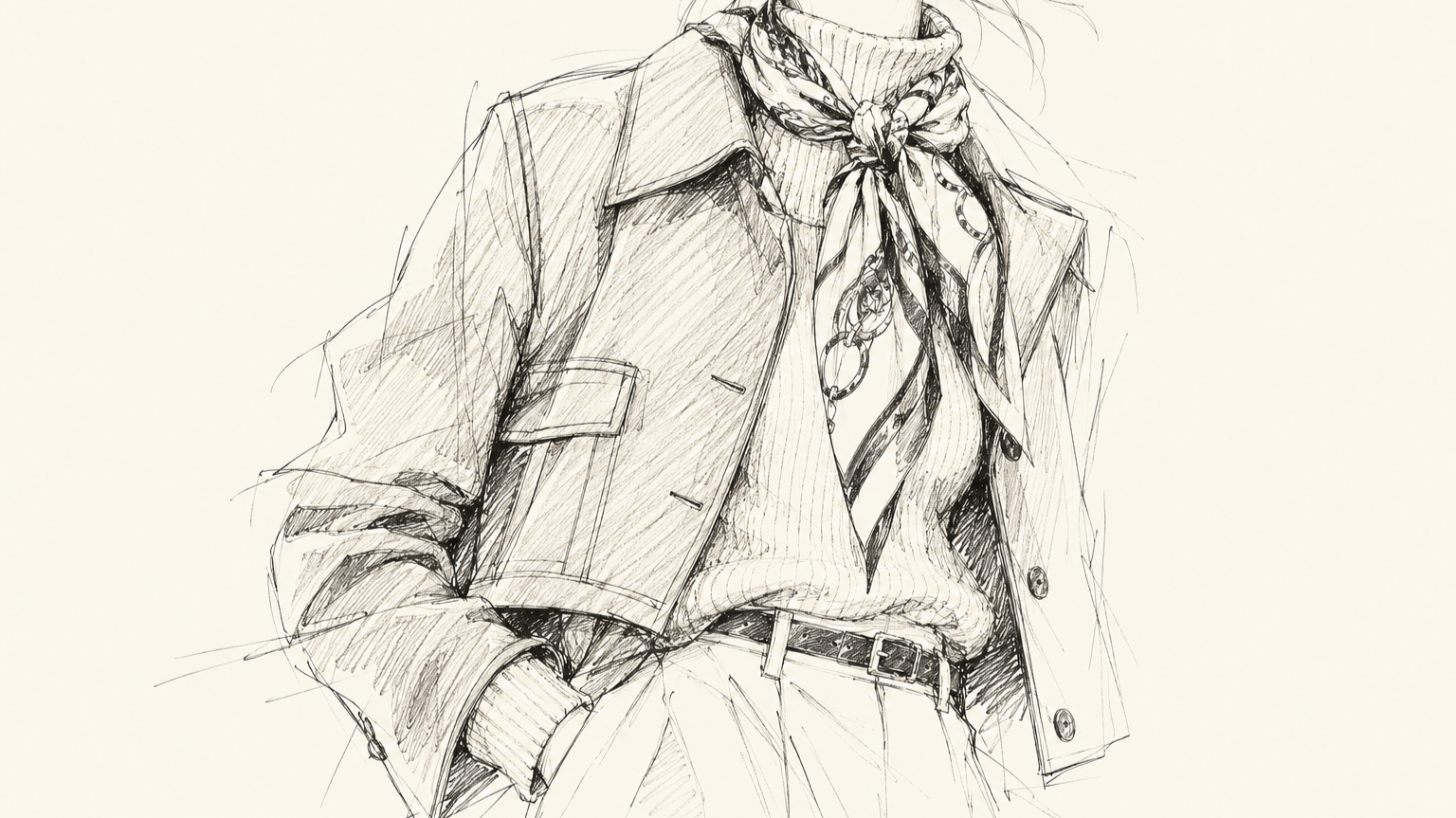
Around the neck remains one of the most visible treatments, although contemporary styling tends to be less ceremonious than the neatly knotted silk square associated with traditional formal dressing. Smaller scarves are being worn closely with shirts, simple knitwear, T-shirts and relaxed tailoring, while longer or larger versions can fall more loosely down the front of the body. The appeal often comes from contrast: something as refined as printed silk becomes more modern when it appears alongside clothes that are comparatively straightforward rather than being surrounded by an entirely polished, coordinated look.
Over the hair, the triangular kerchief has become another important part of the current scarf vocabulary. This is not one single aesthetic. Depending upon the size of the square, the position of the knot and what accompanies it, a headscarf can move between the casual language of the bandana and much more glamorous references to mid-century dressing. What feels particularly current is the ease with which those histories are mixed with contemporary clothes, allowing silk to sit alongside denim, oversized shirts, modern sunglasses or tailoring without the overall effect becoming costume. British Vogue’s spring coverage was particularly useful in demonstrating this breadth, showing that the same accessory could migrate from hair to neck, hips, handbag and torso without one treatment being positioned as the definitive way to wear it.
The waist has become equally important. Scarves threaded through belt loops or knotted across trousers and skirts provide a softer alternative to leather and allow print to interrupt an otherwise plain area of an outfit. The idea has developed further through longer, fringed scarves and pareo-like pieces, while Pre-Fall 2026 collections have continued to use scarves as layering tools around the waist rather than treating the technique as a passing spring novelty. Vogue described pareos wrapped over trousers, built-in bandanas and silk scarves looped around waists as part of the trend’s evolution into pre-fall, suggesting that scarf dressing is becoming a broader method of adding character rather than one particular styling trick.
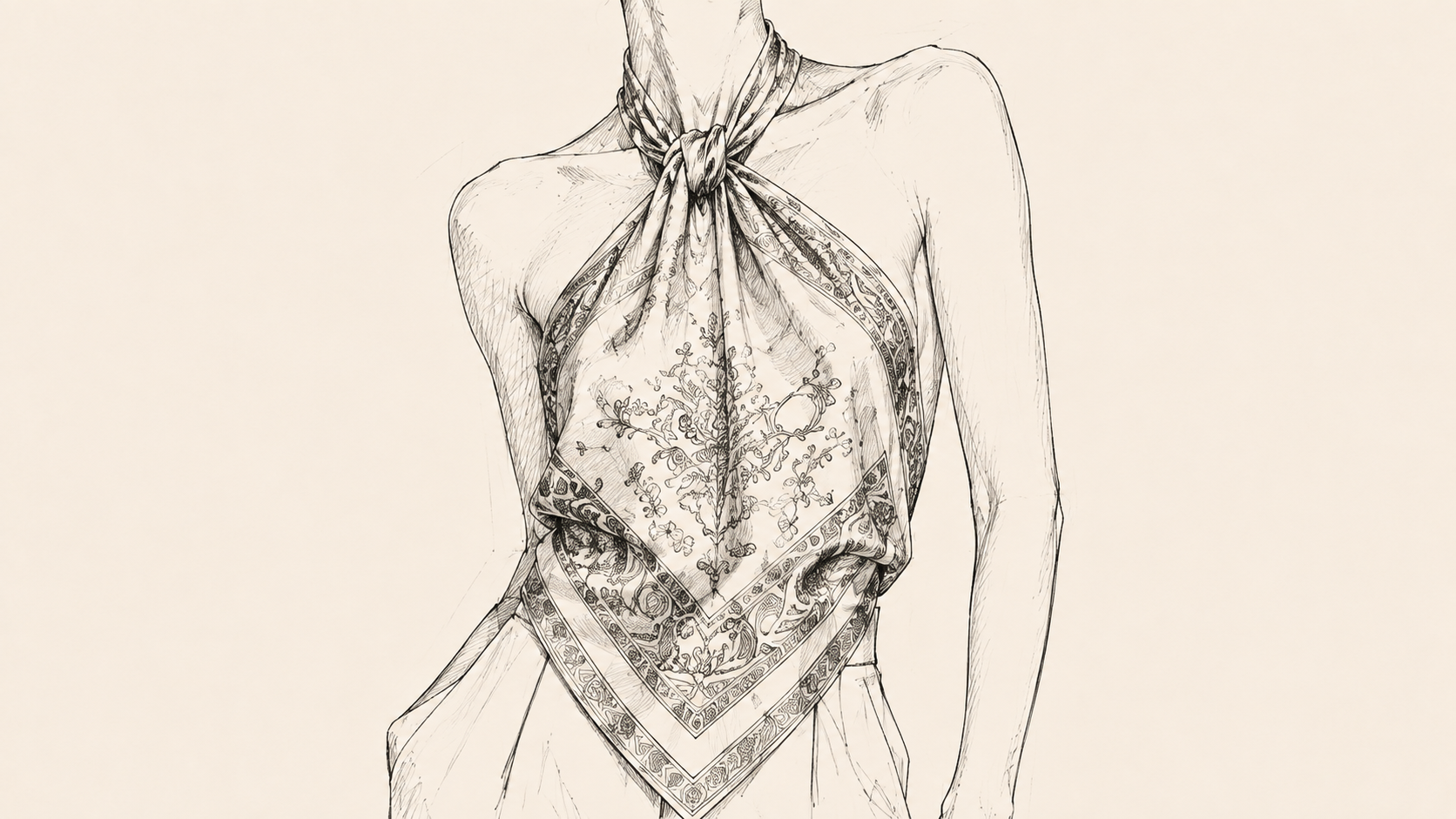
Larger silk scarves are also crossing the boundary between accessory and clothing. They can be folded into halter tops, wrapped across the torso or draped over existing garments, and designers have increasingly embraced this ambiguity rather than attempting to disguise it. The scarf remains recognisable as a scarf, complete with decorative borders and pictorial printing, but the wearer temporarily assigns it another function. This ability to become clothing without being permanently converted into clothing is one of the clearest reasons larger squares have benefited from the trend.
What size silk scarf is fashionable in 2026?
There is no single fashionable size because small and large scarves are currently doing different jobs. A small kerchief is particularly effective around the neck or hair, where relatively little fabric is required and a concentrated flash of colour or pattern can be enough to alter an outfit. A larger square becomes more useful when the wearer wants to move beyond those treatments because there is enough silk to cover the shoulders, wrap the waist or become part of the clothing itself.
This makes the traditional large square unexpectedly relevant to contemporary scarf dressing. A scarf measuring around 90 × 90 cm, for example, can display a complete illustration when opened flat but can also be reduced dramatically through folding. That gives it an important advantage over a much smaller scarf: the large square can become visually small, whereas a small kerchief cannot acquire the additional fabric required to become a substantial wrap or top. Size in 2026 is therefore better understood in terms of possibility than fashionability.
The practical question when choosing a silk scarf is not simply whether 50 cm, 70 cm or 90 cm is currently receiving the most attention. It is what you intend to do with it. Someone who enjoys a neat neck knot may prefer the manageability of a smaller square, while someone attracted to the current idea of scarf dressing is likely to appreciate the greater range offered by larger dimensions. That is a more useful distinction than pretending one measurement has suddenly rendered all the others unfashionable.
What prints are fashionable for silk scarves in 2026?
There is similarly no single print that defines the year. This is important because trend reporting can easily turn a broad movement into a false degree of certainty, declaring that paisley, florals or equestrian imagery have somehow won when the runway evidence is considerably more varied. Vogue’s Spring/Summer 2026 coverage points instead towards patterned and multicoloured silks generally becoming more important, while British Vogue highlighted a range extending from graphic minimalist scarves to swirling 1970s-inspired designs and the long-established equestrian tradition of the silk carré.
The larger story is that fashion has become increasingly interested in the visual language of the scarf itself. Decorative borders, pictorial centres, elaborate pattern and the contrast between an image viewed flat and an image seen after folding all sit somewhat apart from the restrained aesthetic that dominated much of the conversation around “quiet luxury”. In 2026, there appears to be more room for silk to behave as something visibly decorative again, without that necessarily requiring maximalist clothing everywhere else in the outfit.
This is one of the qualities worth examining carefully when choosing a scarf. A design should not only be judged as a complete square because it will spend relatively little of its life appearing that way. Once folded, much of the central artwork may disappear and the corners or borders can suddenly become the only visible part. A design with thoughtful colour placement can therefore produce several quite different appearances depending upon the fold, which is particularly valuable when the current fashion for scarves is built around changing how they are used.
The scarf print is becoming fashion in its own right
The most interesting development of late 2026 may be what happens when scarf dressing no longer requires an actual scarf. Designers have increasingly begun borrowing the design language of the foulard and applying it to clothes, allowing decorative borders, silk printing, draping and scarf-like construction to migrate into tops, jackets, skirts and couture.
Vogue’s 1 September examination of the scarf’s renewed relevance points to Celine, Area, Hermès and Givenchy among the designers exploring this territory. At Area, the relationship became particularly explicit through Fall 2026 looks inspired by and constructed from vintage scarves, while elsewhere the visual codes associated with printed silk have been absorbed into conventional garments. This suggests that the 2026 scarf trend is expanding beyond the accessories category itself: the scarf is not merely something fashion is wearing more frequently, but something designers are using as a source of ideas.
That distinction gives the trend greater substance. A small accessory can become fashionable for a season because people suddenly agree to wear it, but when its proportions, printing and methods of draping start influencing the construction of other clothes, it begins to shape a broader aesthetic. The silk scarf of 2026 is therefore both an object and a design language.
Why have silk scarves become fashionable again?
Fashion’s cyclical nature provides part of the explanation, but saying that old things eventually return does not explain why a particular object feels useful at a particular moment. The silk scarf arrives with an exceptionally rich archive, from Hollywood travel photographs and glamorous head coverings to equestrian imagery, 1960s graphics, 1970s colour and generations of elaborate European foulards. Designers have plenty of history from which to borrow, and Harper’s Bazaar traced the current revival in part through Michael Rider’s work at Celine, where an enormous printed silk scarf suspended across the Paris headquarters for his debut became an unusually literal symbol of the object’s renewed importance.
The more contemporary explanation, however, lies in individual interpretation. Most garments reach the wearer with their fundamental relationship to the body already decided. Trousers contain two legs, a shirt has sleeves and a coat has an obvious front and back. A silk square is considerably less prescriptive. The designer controls the artwork, colours, proportions and material, but the wearer decides which parts of that design will actually be seen. One fold can remove the centre entirely, another can expose two corners, while wrapping the scarf around the body can turn a border that looked secondary on a table into the dominant feature of the outfit.
That degree of personal intervention feels particularly relevant in a fashion culture increasingly shaped by shared social feeds, recommendation algorithms and rapidly replicated aesthetics. Two people can own the same scarf and produce two noticeably different results because the final composition is not complete until somebody decides how to fold and place it. The silk scarf may be traditional, but the freedom to continually reinterpret an object rather than consume it in one fixed form feels decidedly contemporary.
The Pinterest UK figures add some weight to that interpretation. The fact that searches for “silk scarf styling” grew much faster than searches for “silk scarves” themselves suggests that at least some of the renewed interest concerns experimentation rather than ownership alone. It would be wrong to treat one platform’s search data as a complete explanation of consumer behaviour, but it supports what the runway evidence already indicates: 2026 is as much about how the scarf is being worn as the scarf itself.
What colours are fashionable for silk scarves in 2026?
The evidence does not support naming one definitive scarf colour for 2026, and attempting to do so would make the trend appear narrower than it is. Spring and summer saw a broader return to stronger colour, with Vogue’s end-of-summer review identifying vivid shades including teal, turquoise and red among the season’s successful colour stories. Autumn collections have continued to make room for stronger colour alongside more restrained combinations, meaning both expressive and neutral silk scarves can sit comfortably within the current fashion landscape.
A scarf also interacts with colour differently from a coat, dress or pair of trousers because the wearer controls how much of the design appears. A highly saturated 90 cm square can become little more than a narrow flash of colour when folded at the neck, while the same scarf opened over the shoulders can dominate the outfit. Neutral designs have the opposite flexibility, remaining understated in a small fold but revealing considerably more detail when opened. Rather than searching for the official colour of the 2026 scarf, it makes more sense to consider whether the palette works in several configurations and alongside the clothes with which it will actually be worn.
What makes a good silk scarf for the 2026 trend?
The current emphasis on versatility makes construction more relevant than it might initially appear. A scarf designed to be repeatedly folded, knotted and draped needs fabric that behaves well rather than simply photographing beautifully when laid flat. Silk twill has long been associated with substantial square scarves for precisely this reason: its diagonal weave gives the fabric enough structure to hold folds and knots while retaining the fluidity and lustre expected of silk. Lighter silks can produce a softer effect, while more substantial twills tend to provide greater definition when shaped.
Size should be considered together with construction, followed by the design itself. Look carefully at the border, corners and distribution of colour rather than focusing exclusively on the central illustration because those peripheral areas may be the only parts visible when the scarf is tied. A successful square can reward different folds by revealing different fragments of the design rather than depending upon one complete picture that disappears as soon as the scarf reaches the body.
Finishing also deserves attention. Rolled hems are characteristic of many traditionally constructed silk squares, and hand-rolled edges are associated with a more labour-intensive finishing process. These details do not automatically make one scarf more fashionable than another, nor should they be used as shorthand for value without considering the quality of the silk, printing and design as a whole. They do, however, help explain why apparently similar silk squares can feel and behave differently once worn.
This is where specialist scarf makers can add something that general fashion coverage cannot. Runway reporting tells us that scarf dressing is fashionable; understanding silk explains which scarves can actually accommodate the different folds, knots and treatments the trend encourages.
Is the silk scarf trend only for summer 2026?
Although Spring/Summer provided the most obvious setting for scarf tops, head coverings and hip wraps, the trend has already moved beyond warm-weather dressing. Vogue’s Pre-Fall coverage found the scarf evolving into a layering tool, with silk around waists and pareo-like treatments appearing over trousers, while its July Fall 2026 guide showed the accessory being used as a major part of outfits at Altuzarra, The Row, Maria McManus, Area and Valentino.
What changes with the seasons is not necessarily the scarf but the context around it. A square used as a top during summer can move underneath tailoring in autumn; a headscarf can become a neck scarf beneath a coat; a larger piece can sit over knitwear rather than bare shoulders. The most extravagant summer treatments will inevitably become less practical as temperatures fall, but the fundamental appeal of the scarf, adding colour, print and an adjustable layer without requiring an entirely new outfit, survives the transition easily.
Will silk scarves still be fashionable after 2026?
No fashion writer can say with certainty which styling tricks will survive several seasons from now, and some details of the present trend will undoubtedly become associated with this particular year. The way a kerchief is tied, the prominence of the scarf belt or the popularity of one specific proportion can change quickly. What gives the silk square more longevity than many micro-trends is that it can respond to those changes without having to be redesigned.
When fashion focuses on the waist, silk can move to the waist; when attention returns to the neckline, the same square can become a neckerchief; when strong pattern is fashionable, it can be opened widely, while a period of restraint allows almost the entire design to disappear inside a narrow fold. The object remains remarkably stable while the interpretation around it changes. That is why silk scarves have survived so many previous occasions on which fashion has announced their return.
The most sensible way to respond to the 2026 trend is therefore not to buy a scarf purely because it is fashionable. It is to notice that fashion has rediscovered something the silk square was capable of all along.
So, what is the trend for silk scarves in 2026?
The defining silk scarf trend of 2026 is scarf dressing, but the term describes something broader than a new collection of knots. Silk scarves are being treated as adaptable pieces of a wardrobe, appearing at the neck and over the hair but also around the waist, across shoulders, on handbags and as tops, wraps and source material for garments. Larger squares have benefited from this versatility, while smaller kerchiefs remain important for more compact styling. Pattern and colour are highly visible, but there is no single print, palette or scarf size that everyone needs to follow.
The more interesting shift is cultural. Fashion has taken an object with generations of etiquette, tradition and recognisable styling attached to it and made it contemporary by loosening those instructions. The designer still creates the square, but the wearer decides which part of it becomes visible, where it sits and what it means within the rest of the outfit. In a year when individuality and styling have become as important as acquiring something new, that makes the silk scarf unusually well suited to the moment.
The silk scarf is not fashionable in 2026 because everybody has finally agreed on the right way to wear one. It is fashionable because fashion has become interested in how many different answers there can be.
Frequently Asked Questions
Are silk scarves in style in 2026?
Yes. Silk scarves have been prominent across Spring/Summer 2026 runway collections, fashion editorial and street style, and the trend has continued into Pre-Fall and Autumn/Winter 2026. What distinguishes the current revival is the breadth of styling, with scarves being worn around the neck and hair as well as at the waist, over the shoulders and as parts of garments.
What is the main silk scarf trend for 2026?
The clearest trend is “scarf dressing”, meaning that scarves are being treated as adaptable styling pieces rather than accessories with one fixed use. Fashion houses and designers have shown silk as neck scarves, head coverings, belts, tops, wraps and focal points within entire outfits.
Are silk headscarves fashionable in 2026?
Yes. Wearing silk over the hair remains an important part of the wider scarf trend, ranging from small triangular kerchiefs to larger squares. Contemporary styling often combines the headscarf with relaxed or modern clothing, which helps separate it from a purely nostalgic or costume-like interpretation.
Are neck scarves fashionable in 2026?
Yes. The traditional neck scarf remains current, but it now exists alongside far more experimental treatments. Small squares are being worn close to the neck, while longer, printed and fringed scarves can be left looser or combined with tailoring, knitwear and otherwise simple clothing.
What size silk scarf is fashionable in 2026?
There is no single fashionable size. Smaller scarves work particularly well as neckerchiefs and headscarves, while larger squares offer more options for wrapping around the waist, shoulders or torso. For someone interested in scarf dressing rather than one specific styling method, a larger square generally provides greater versatility.
What silk scarf prints are fashionable in 2026?
Patterned silk is highly visible in 2026, including graphic, floral, abstract, vintage-inspired and traditional foulard designs. The evidence does not point towards one dominant motif; the broader trend is towards allowing the scarf’s decorative character and print to become a meaningful part of the outfit.
How do you wear a silk scarf in 2026?
Silk scarves can be worn around the neck or over the hair, threaded through belt loops, tied across the waist, draped over shoulders, attached to handbags or, with larger squares, folded into tops and wraps. The most recognisably 2026 approach is not one particular knot but choosing a treatment that changes the scarf according to the clothes and occasion around it.