
Macclesfield Textile Week 2026: What Britain’s Silk Town Can Teach Fashion
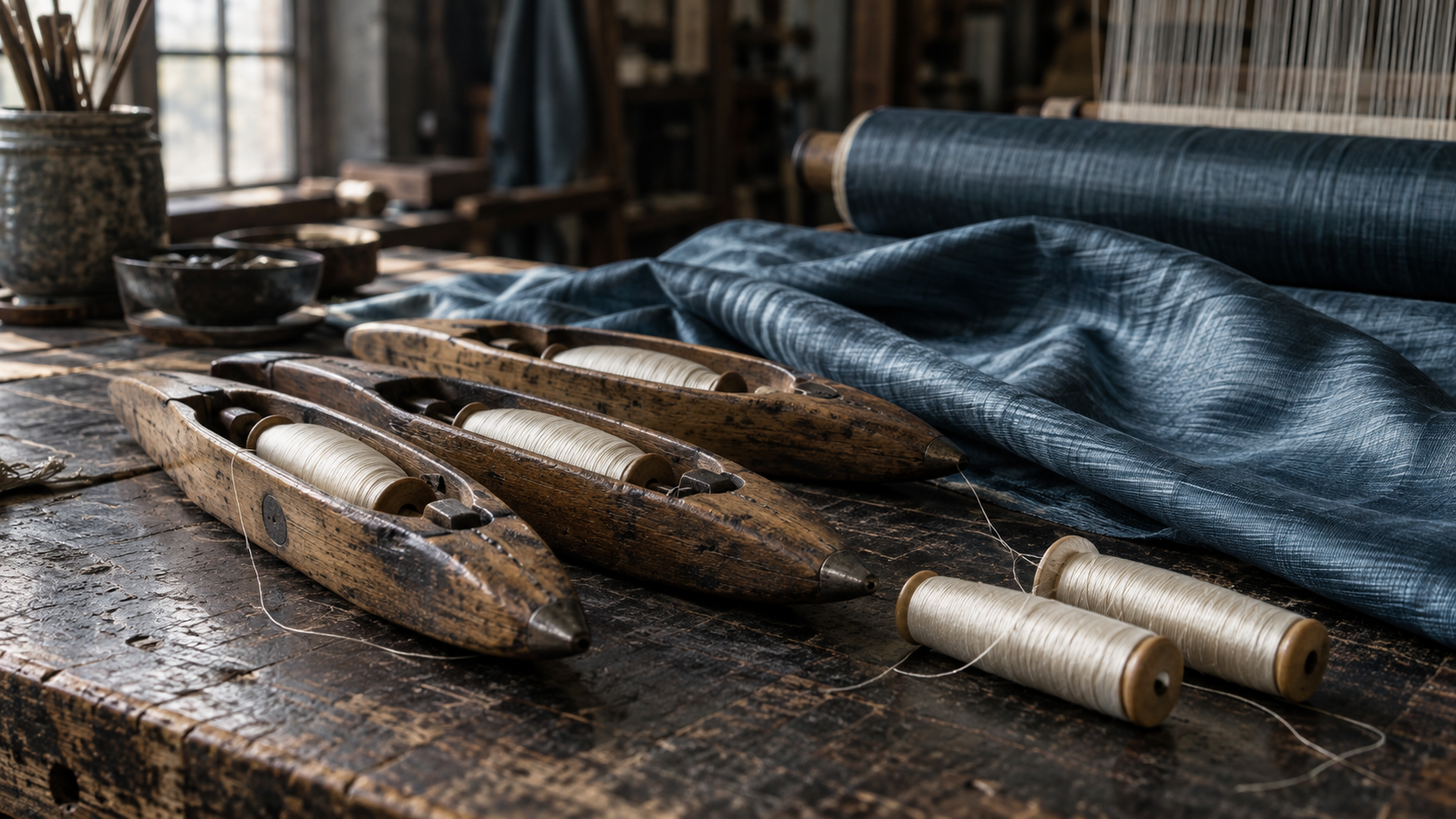
AI-generated editorial illustration of textile-making tools; not a photograph of Paradise Mill or the festival.
As Macclesfield prepares for its first Textile Week, the most interesting question is what a silk town can teach us about the clothes we buy: how they are made, whose knowledge they contain and what deserves to survive.
A silk scarf arrives in a shop with its labour concealed. The edge is finished, the drawing resolved, the cloth folded into a small, persuasive square. Unless someone explains the stages behind it, the buyer sees the result without necessarily understanding the work. A visit to a textile town offers another way of looking: begin with the making, then return to the object.
Macclesfield’s first Textile Week provides an occasion to do just that. For readers interested in silk, its appeal lies less in adding another event to the autumn calendar than in bringing the discussion of cloth back to the places, equipment and people through which it becomes tangible.
When is Macclesfield Textile Week?
Macclesfield Textile Week takes place from 19 to 27 September 2026. The organisers describe a community-led collaboration between Macclesfield Community ArtSpace and The Silk Museum, with 50 events across 15 locations. The programme includes exhibitions, talks and practical workshops; some activities are free, while others require tickets. This is a researched preview, not a report from an event we have attended. Read the organisers’ announcement.
Begin with the silk, rather than the shopping
The Silk Museum introduces visitors to Macclesfield’s textile history through fabric designs, clothing and the machinery of production. Its collections include original pattern books, while neighbouring Paradise Mill preserves historic Jacquard silk looms in their original setting. The museum also explores the local industry’s contribution during the Second World War. These are different kinds of evidence: a pattern records a visual decision; a loom helps explain how an intention could become cloth. Explore The Silk Museum and Paradise Mill.
For someone accustomed to reading a scarf through its printed image, the change of emphasis is useful. Ask where the colour enters the process. Ask whether a particular pattern is woven into the structure or applied to an already woven surface. Ask what changes when a maker chooses a different yarn or adjusts the construction. Questions this specific bring the discussion much closer to the scarf that will eventually sit against the skin.
The programme through a silk lover’s eye
Among the announced events, the study day titled Weaving in Paradise is the clearest starting point for readers who want to examine silk-making in depth. The programme also includes a talk by Patrick Grant, founder of Community Clothing, and a range of workshops and community activities. Check the official programme for individual dates, booking arrangements and any changes before travelling.
Our editorial preference would be to choose one substantial encounter with the making of cloth and leave time to absorb it. A tightly packed itinerary can turn a specialist visit into a succession of rooms. A conversation about one material, followed by close attention to a few objects, may provide a much more useful education. Bring a notebook and ask before photographing: record what the object is, when it was made and what the description actually establishes.
What a mill can change about buying a scarf
The most valuable souvenir may be a better question for the next shop. Instead of asking whether a scarf is luxurious, ask how its fabric was made. Instead of treating a place name as a complete account of provenance, ask which stages happened there. The designer’s location, the origin of the fibre and the site of weaving or printing are distinct pieces of information; a useful product description should not blur them into one romantic address.
This is the distinction behind our guide to silk scarf quality. A confident judgement depends on looking at the finished object as a combination of decisions. The museum visit and the wardrobe need not remain separate interests. Each can improve the way we understand the other.
Heritage needs a present tense
It is easy to admire old machinery as scenery. The harder, more interesting task is to understand the knowledge it preserves and the conditions under which that knowledge can remain useful. For a fashion publication, a textile festival deserves attention when it makes that work visible: the judgement involved in setting up a process, recognising an error or understanding why a particular cloth behaves as it does.
Macclesfield’s programme places the historic industry alongside contemporary making and public participation. We should judge that combination by what it helps people learn, rather than by how neatly it fits an image of British heritage. For background before a visit, our existing features on The Silk Museum and Macclesfield’s silk history introduce the setting.
Planning a considered visit
Start with the event you most want to attend, confirm its venue and ticket requirements, then arrange the rest of the day around it. Festival hours may differ from ordinary museum opening hours, and an event booking should not be assumed to include every exhibition or tour. Anyone with access requirements should check the relevant venue directly rather than treating the town-wide programme as a single accessible space.
The point is not to return able to recite every stage of silk production. It is to look at the next scarf with greater attention, recognising that the smooth surface in the box is the end of a much longer sequence of work. That is a useful kind of fashion education, and an excellent reason to look beyond the boutique this September.
Questions before you go
Is Textile Week only about silk?
No. The programme covers a broader range of textiles and making, so select events according to your interests rather than expecting every activity to concern silk scarves.
Is everything free?
No. The organisers describe a mixture of free activities and ticketed events, with limited places for some sessions; consult the current programme before making plans.
Is this a silk scarf shopping fair?
It should not be treated as a dedicated scarf fair. Its relevance here is the opportunity to learn about textiles, craft and the local industry rather than a promise of particular brands or products for sale.
Can I visit the museum outside Textile Week?
The Silk Museum and Paradise Mill have their own visitor programme beyond the festival. Check their current opening arrangements and tour availability directly.
Sources and editorial notes
Researched on 15 September 2026 using The Silk Museum’s announcement, programme and visitor information. Event details can change; the organisers’ listings take precedence. The selection and interpretation above are our editorial judgement, and no interview or on-site visit is implied.